
If there’s any questions or you’d like to know more, please email:
BD@GettysburgChronicles.com
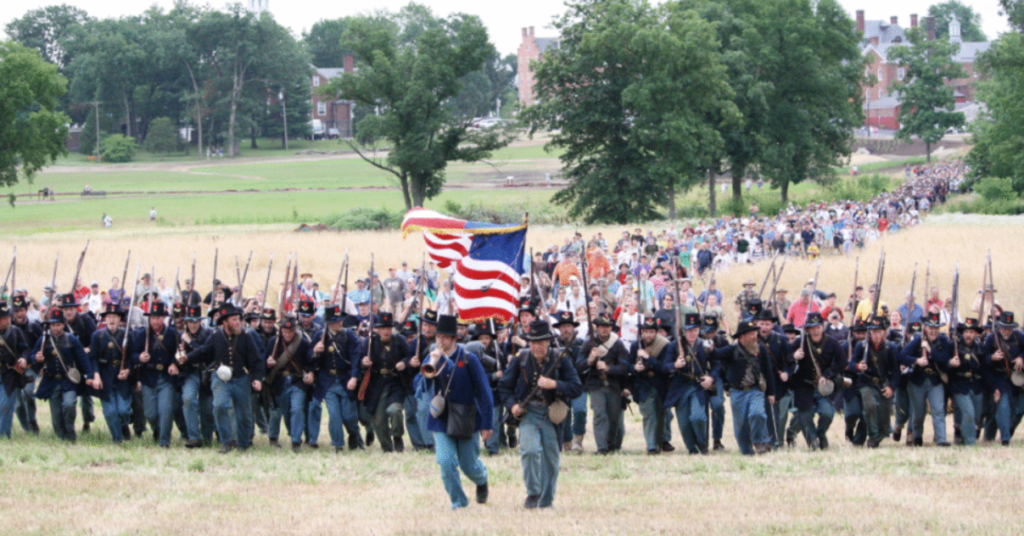
As the northern portions of the battlefield ease, the concentrate of the Confederacy takes their position along the Sunken Lane. This farmer’s road was used so often that it sank into the terrain. Between the Mumma’s Farm and the Sunken Road, both forces would command their soldiers to most certain death. The Confederate troops were in line from the Dunker Church to the Lane, while the Union Troops made a half semicircle formation from the North Woods through the East Woods and towards the Sunken Road.
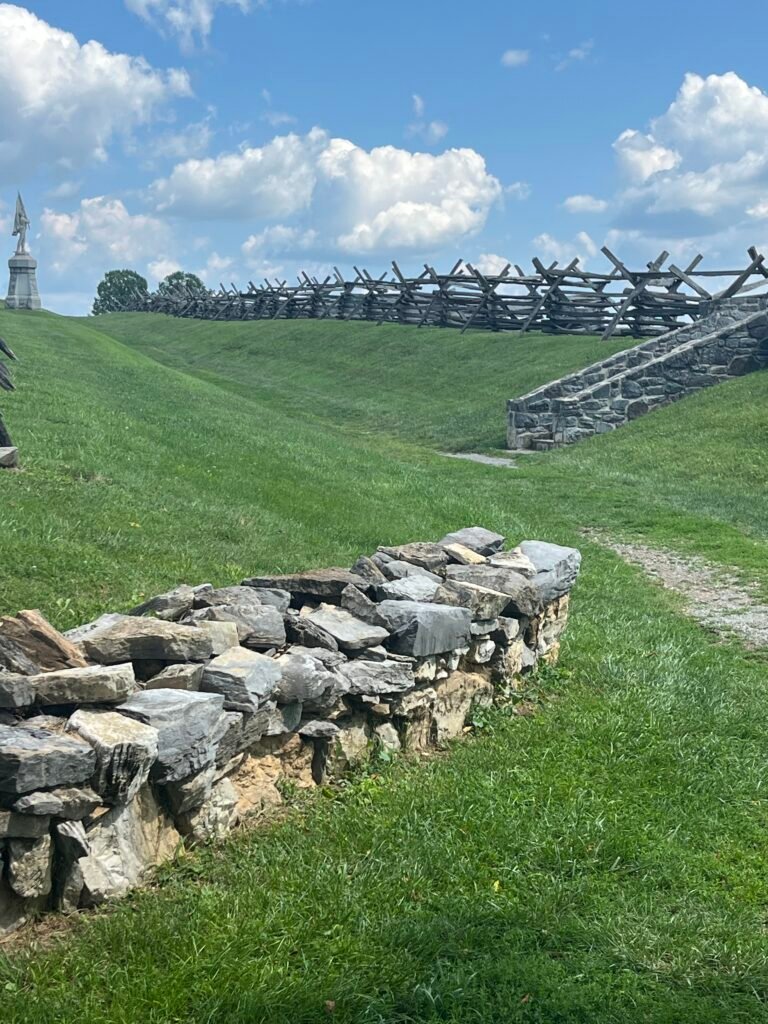
One of the most famous generals of the Confederacy was near Dunker Church under the command of General Stonewall Jackson. To prevent Union sharpshooters, the Rebels set fire to the Mumma farmhouse. The rebels were positioned along the lane and they ducked down to not be seen. They waited for the Union soldiers to attack and not fire till they “saw the white in their eyes”.
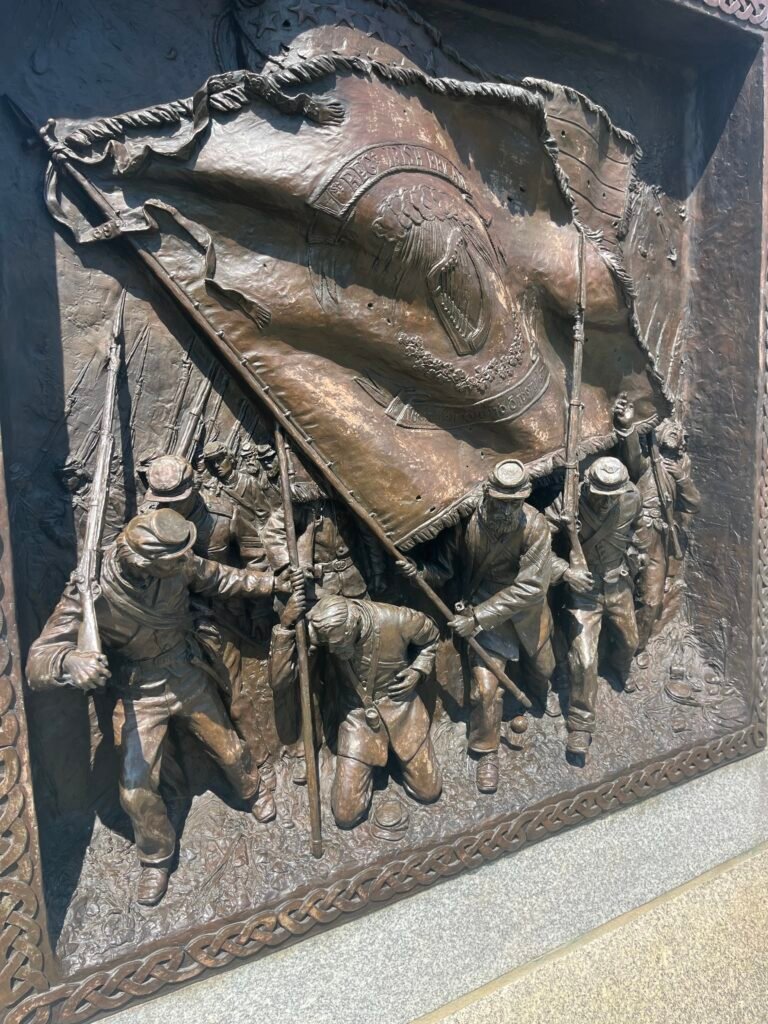
One of the most known brigade of the location is the Irish Brigade. The brigade consisted of the 63rd, 69th, and 88th New York. They were led by the emerald green banners. They started the day with 1000 soldiers and officers. At the end of the day, over 600 were killed and or wounded. This flag below was one of the banners.
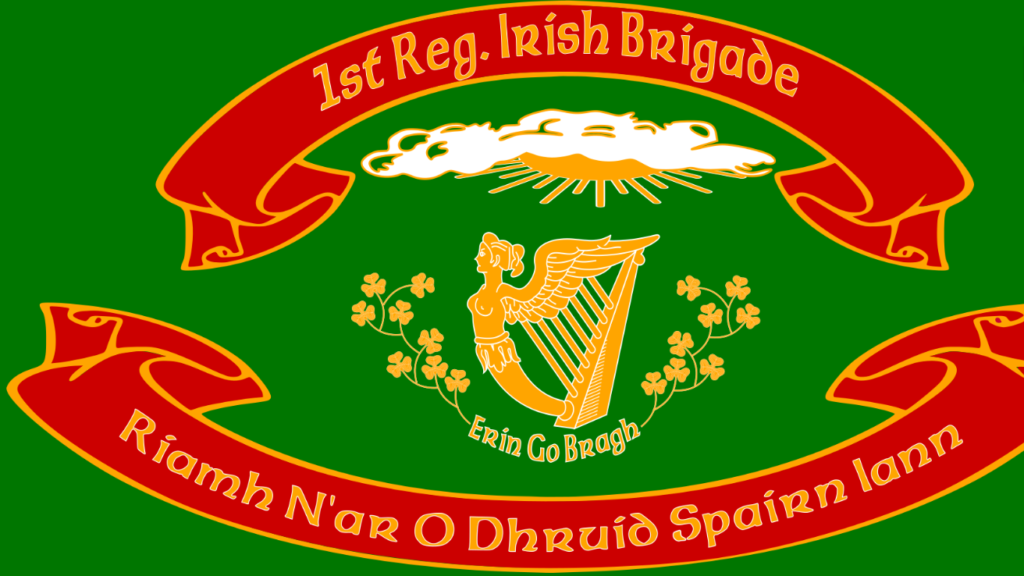
Their fighting war cry from the 69th New York was the following: “Faugh a Ballagh” – Clear the Way!
After three small battles at Crampton, Fox, and Turner’s Gap, the Union and Confederate army converged on the biggest battle of the Maryland Campaign. Both armies moved towards this little town. Confederates called it the battle of Sharpsburg, while the Union called it the battle of Antietam. With the Rebel forces divided with some of it attacking Harpers Ferry and capturing the Union garrison, the other half is here preparing for battle against most of the Union forces. Even before the battle began, here are the facts:
This picture that is located in front of the Antietam’s Visitor Center shows the aftermath of the battle. It shows the cannon ball damage to the Dunker Church, and those soldiers killed on the field.
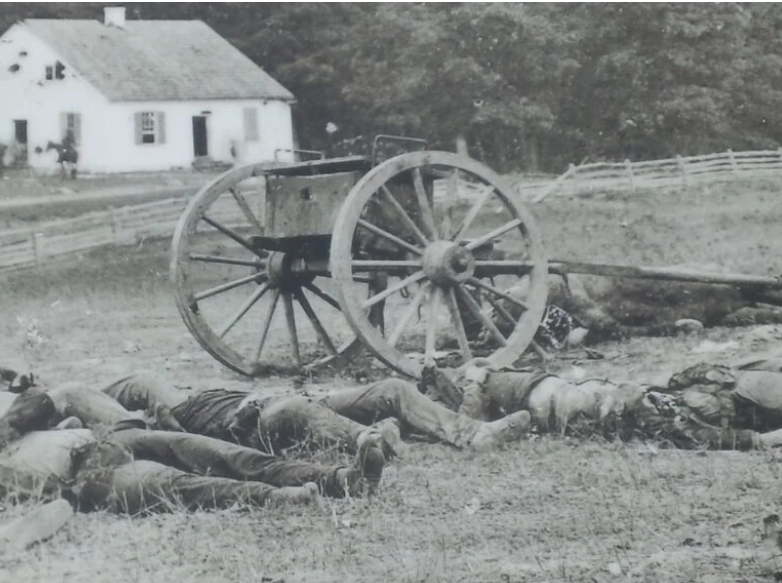
On September 17th, the bloodiest battle of the Civil War began. Three phases of the morning, afternoon, and early evening occurred with significance in each time frame. The morning action that was between 5 to 9 a.m. happened on the northern part of the battlefield that included the West Woods, North and East Woods, and the Cornfield. When the fighting eased around 9 a.m., the Confederates retreated towards the West Woods.
There was over 8,000 casualties that were either killed or wounded. This fighting occurred on 24 acres of land. Some regiments of both armies were cut to pieces in less than 30 minutes. As an example, the 12th Massachusetts brought 334 soldiers to the morning fighting. As the fighting eased, less than 100 soldiers remained. It was the highest casualty rate of any Union regiment at Antietam.
Confederate General Robert E. Lee began the first invasion of the North on September 4th, 1862. They moved across the Potomac River and traveled into Mary-land and towards Frederick. As they crossed the Potomac, the Union was on their tails from being centered outside Washington D.C. They were now in enemy territory. Even though the farmlands were rich and green with food, they moved at a snail pace. As they approached Frederick, Maryland on September 9th, portions of the army were captured in town in the picture below.
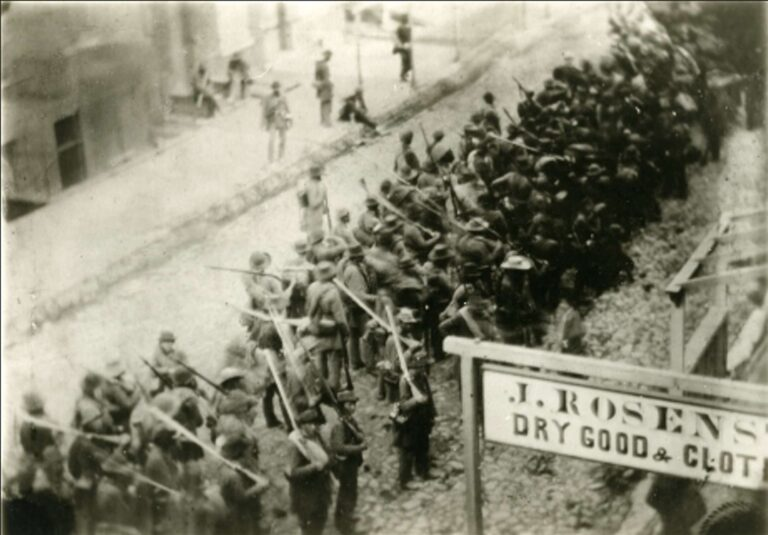
The signage of Jacob Rosenstock’s Rosen’s Dry Good and Clothing store is the clue. This location was on Patrick Street in the downtown Frederick on September 12, 1862. This is the only known picture of Confederates marching in columns of fours.
As the soldiers arrived into the city, Confederate generals gathered and conversed about the next move. Having cigars near the fire was a common thing for the leaders to do. Somehow, though, after the Confederates have moved to the west towards Boonesboro and Harpers Ferry, was that the orders were left on the ground. Lee wanted to crush the Union garrison at Harper’s Ferry, so the orders had the army divide and hopefully accomplish the objective.
The Union was about a day behind the Confederate soldiers. Around 12 p.m. on September 13th, portions of the 12th Union Corps arrived into Frederick. As they moved towards the town, portions of the regiments walked through old campgrounds that were still smoking from the previous army.
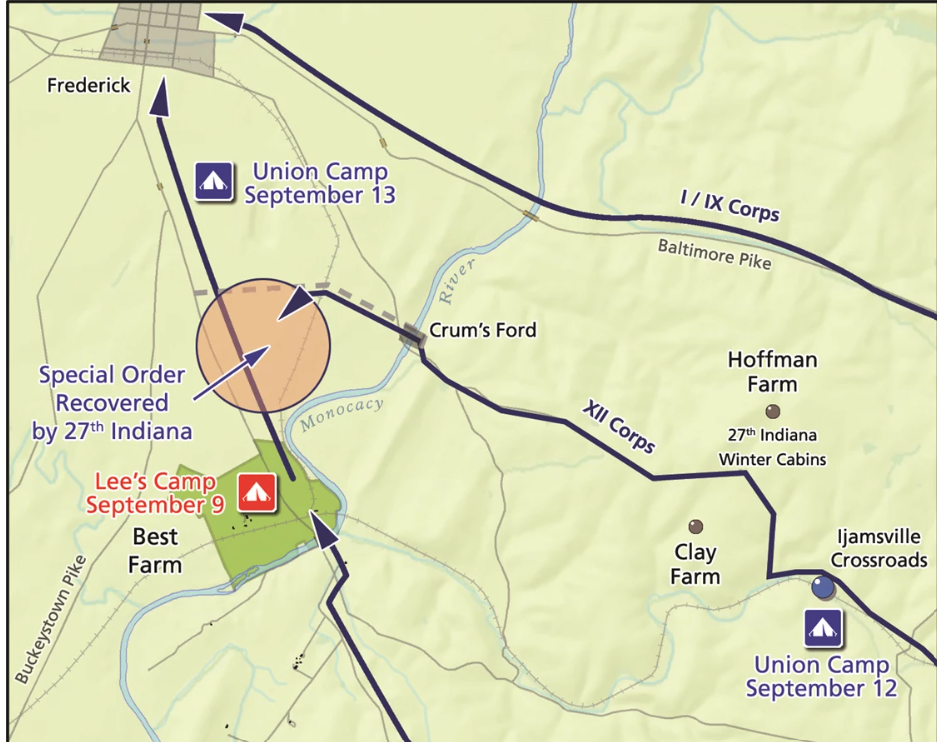
In one of these campgrounds, Corporal Barton W. Mitchell of the 27th Indiana Volunteers discovered cigars wrapped in a piece of paper lying in the grass. He handed the paperwork of the important document up the line of command. As the paperwork continued to go up the line of leadership within the Corps, it was read by the following:
George McClellan was overwhelmed with happiness since he knew where the Confederates direction and objective. He yelled out in glee, “Now I know what to do!”.
The start of the 164th anniversary of the Antietam/Maryland Campaign begins. Remembering the soldiers trekking through the wilderness northward to give farmers some time to recover from warn-torn Virginia would have been a sight to see. Multiple battles were fought throughout Virginia in 1861 and 1862, and the Confederate Army needed to give their citizens a brief break. This would be Confederate Robert E. Lee’s first invasion of the North.
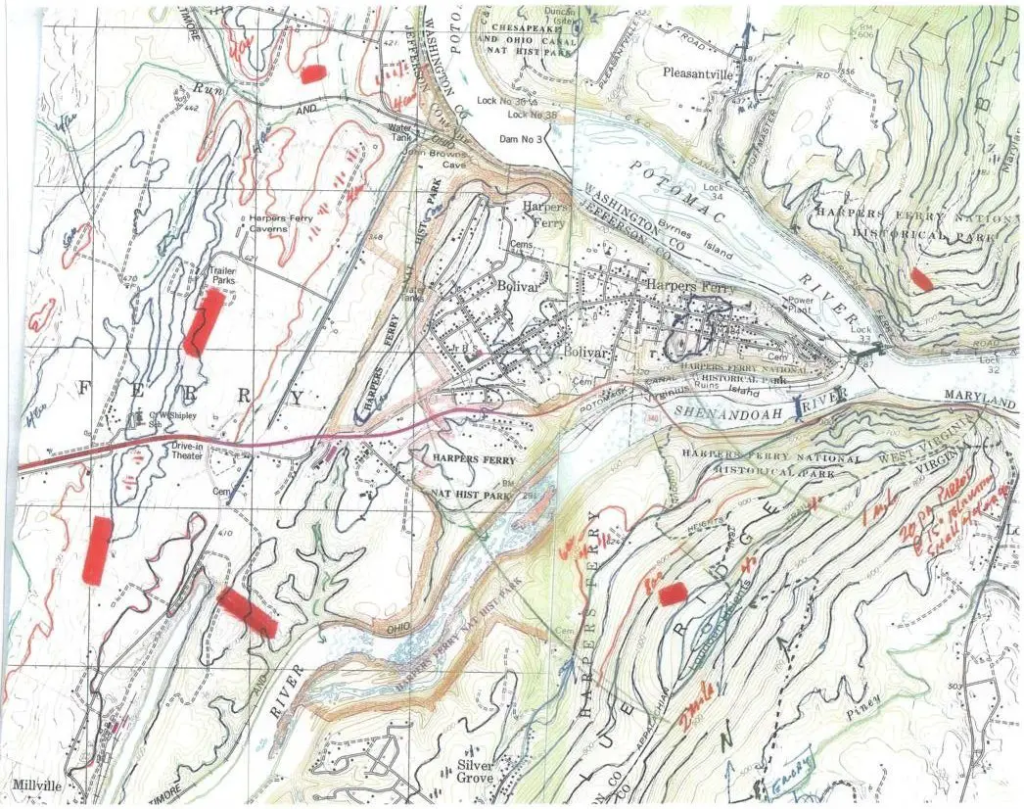
The Confederate army containing approximately 55,000 soldiers traveled across the Potomac River on September 4, 1862, into the vast lustfulness of Mary-land. On their heels were the Union under the commander of General George McClellan and his army of around 84,000 soldiers at his disposal. Lee’s goal was to move into Pennsylvania, but the Union had other plans. The Union garrison that was within Harper’s Ferry was close enough to Virginia that they may threaten the supply lines and telegraph system that would be supporting the Confederate advances.
Confederate forces surrounded the town and captured the Union garrison stationed there. Overall, the Union forces surrendered 73 artillery cannons, 13,000 rifles, and approximately 12,000 soldiers. The commanding officer of the Confederacy at Harper’s Ferry was General Stonewall Jackson. His victory was one of the greatest of his storied career and resulted in the largest surrender of Union soldiers during the war.
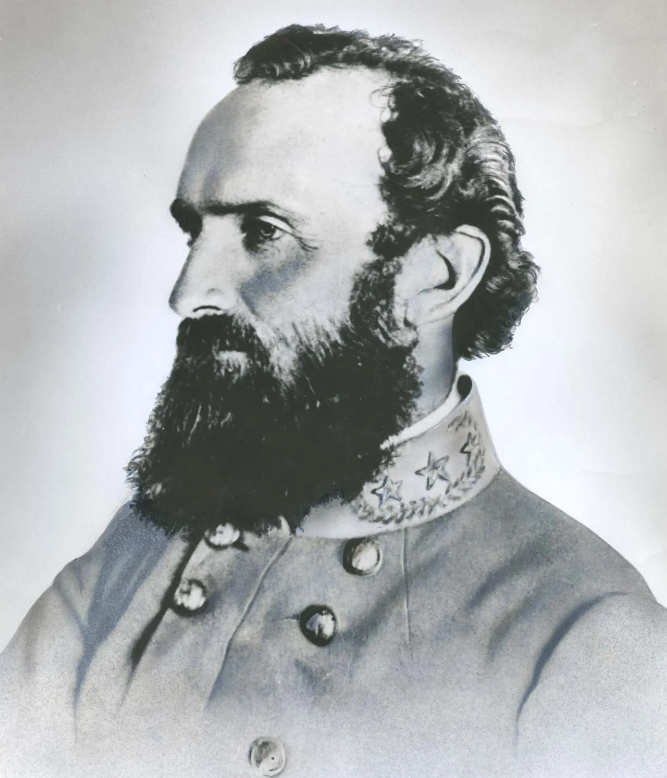
Three other battles occurred in Mary-land prior to the battle of Antietam that happened on September 17th. They were the battles of Crampton, Fox, and Turner’s Gap which are also known as the Battle of South Mountain. These battles happened only three days before the Antietam. The battle of South Mountain halted the Confederate invasion of the North, and began for General Lee to concentrate his forces around Antietam.
This regiment was mustered into service within the first few months of the Civil War in June 1861. They first organized in the fairgrounds south of Grand Rapids, and then left for Washington D.C. on June 13th. This regiment was consisted of soldiers from Kent, Iona, Ingham, Muskegon, and Ottawa counties which surrounding the countryside around Grand Rapids. This first commander of this regiment was Col. Daniel McConnell, pictured below. He had some military experience within the Mexican War.
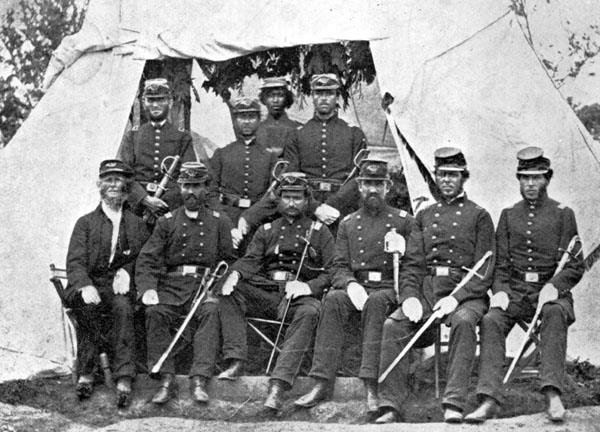
When they departed for Washington D.C., the 3rd Michigan infantry regiment had 1,040 soldiers and officers. They took the same type of transportation to get from Michigan to Washington D.C. like their previous Michigan regiments. They left Grand Rapids on railroad to Detroit, boarded a steam ship to Cleveland, and then rode the rails the rest of the way to their destination. The 3rd Michigan arrived in Washington D.C. on June 16th, 1861.
The 3rd Michigan was at the battle of Manassas in July 1861, but only in reserves. Due to unpopular interactions with the soldiers and ill health, Col. Daniel McConnell resigned his commission on October 22, 1861. His next in line, Stephen G. Champlin was promoted to colonel the very same day.
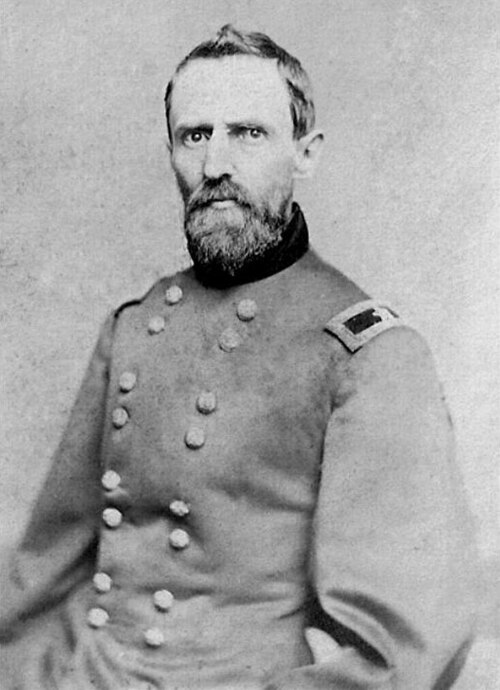
Their first real battle was the battle of Fair Oaks or also called Seven Pines in early June 1862. They would have 30 soldiers killed, 124 wounded, and 15 missing. Col. Champlin was wounded in the hip, and received a 30-day furlough, and then returned to commanded the 3rd Michigan. In August 1862, at the 2nd battle of Manassas, his hip injury returned and he went back on medical leave. Due to the injury, a new commander had to be chosen. The commander that started out as Captain Bryon Root Pierce of Company K, would now become Lieutenant Colonel of the 3rd Michigan.
The picture below shows the 1st Michigan soldiers standing around Fort Wayne, Detroit, in 1861. This black and white photo is 165 years old this month. Look at the contrast of the uniforms and the glare of the soldiers onto the photographer. It seems like they are are dressed in Federal uniform before they depart for Washington D.C. Upon a zoomed-in version of the picture, most of the soldiers on the left have their bayonets in their rifles and are ready to get marching. All of the soldiers in this photograph have their caps on, along with nice black shoes.
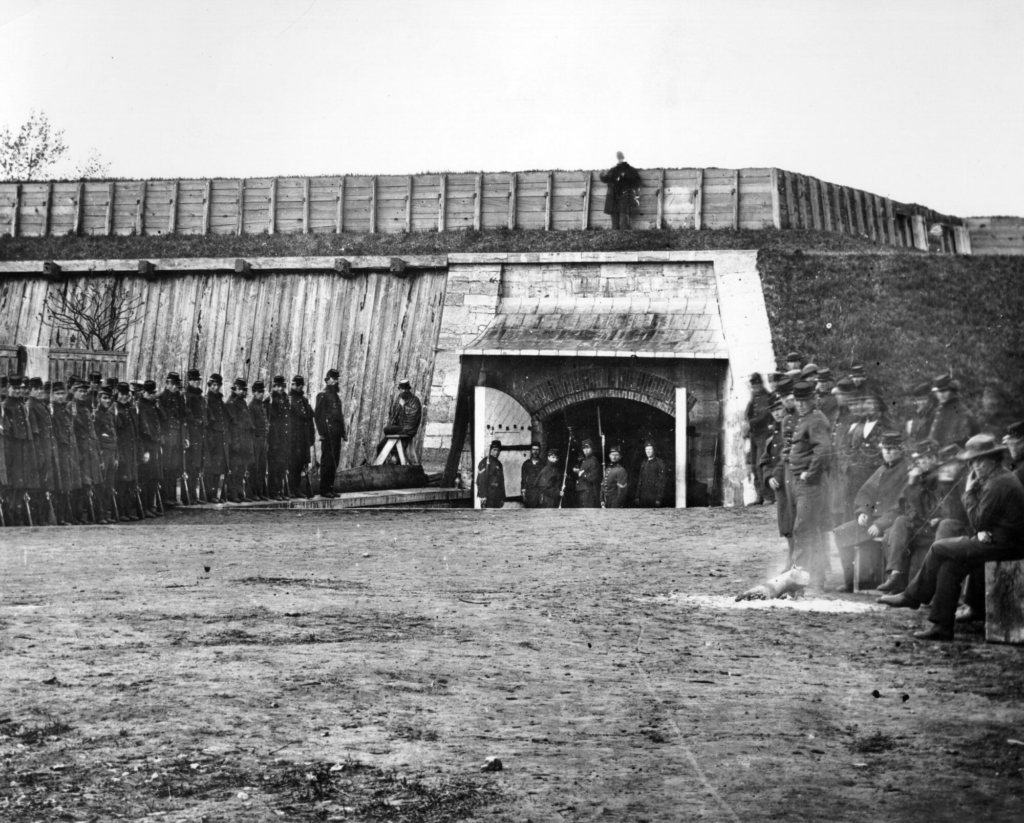
What else would these soldiers of the First Michigan be thinking about heading off to war? Some of them are smiling at the camera, while the ones on the extreme right seem to be sitting and pondering the task at hand. I wonder how many of these soldiers actually survived the Civil War. The world will never know, because there are no names to the soldiers within this picture.
To uphold the United States Constitution, each state had to commit one regiment to the United States military. On April 16, 1861, one regiment from the state of Michigan was formed. The signed a three-month volunteer paperwork to serve. This one regiment had ten companies included within it, and it was completed on April 29th, 1861. The reason for this was the attack on Fort Sumter on the 12th of April.
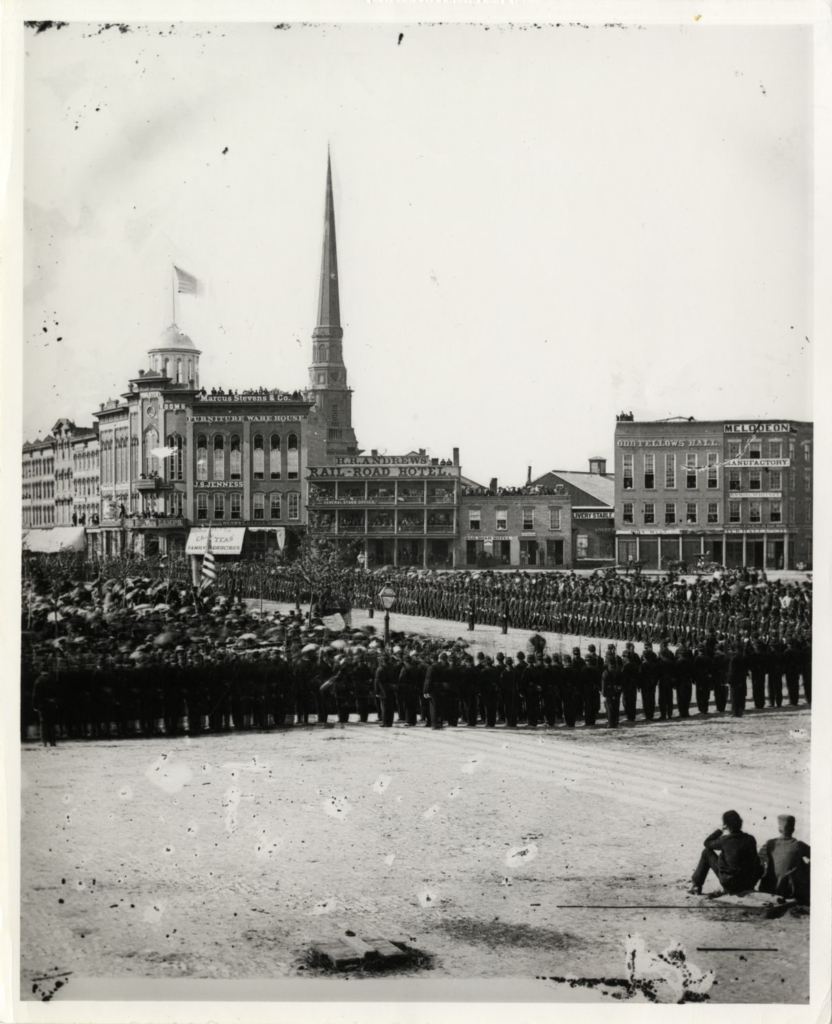
Within these 10 companies were approximately 798 soldiers and enlisted officers. This photograph shows the presentation of colors to the 1st Michigan Infantry on their departure on May 11, 1861. They arrived in Washington D.C. five days later. A few days after their arrival, they attacked Alexandria, Virginia, a day after the state seceded from the Union. Little incident occurred on May 24th, but martial law was enforced for the city throughout the Civil War. When Alexandria, Virginia fell to the 1st Michigan, Col. Orlando Wilcox stated “Alexandria is ours” as two-thirds of the population fled the town. The city became a headquarters for U.S. military railroad, along with one of the largest Union hospital centers.
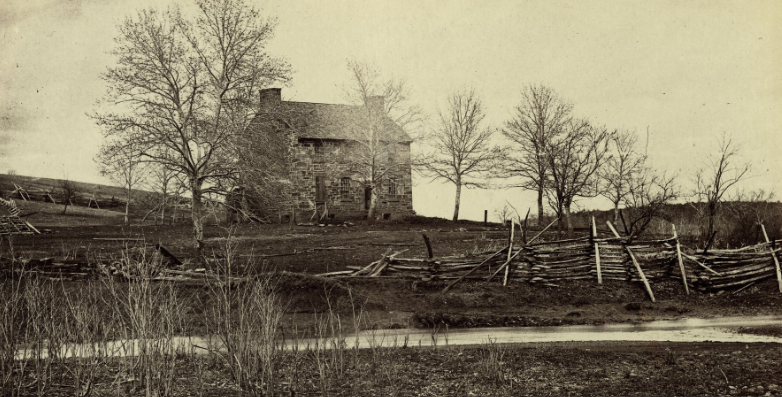
A few months later, on July 21, 1861, the first battle of Manassas began. The 1st Michigan was commanded by Major A.F. Bidwell within the 2nd Brigade that was commanded by Col. Orlando Wilcox. It was a hard-fought battle, but the Union loss with over 2700 hundred soldiers causalities, with around 90 causalities from the regiment itself. The 1st Michigan was then sent home and was mustered out on August 7th, 1861.
However, once returning to Michigan, the regiment morphed and signed three year papers and served as the 1st Michigan through Antietam, Fredericksburg, and Gettysburg, and other battles after 1863.
What happens after a battle, especially one that lasts around three days? Soldiers who survived tell others of their survival, tales of what they saw and heard, and looking for comrades that could be anywhere in town due to the mass confusion of battle. Terrible things occur though, and some of their friends or family members may be wounded or even killed.
With everything in motion around Gettysburg after the battle on July 3rd, the first thing was to rejoice about winning the battle. The next thing would be taking care and finding the wounded around the battlefield. Luckily, the citizens of town were welcoming and trying to help soldiers, both Union and Confederate, that were wounded and taking care of their needs. Prior to the Union army leaving town, over 14,000 Union soldiers along with 6000-8000 Confederate troops needed attention.
Whether if it was to give them water, food, fresh bandages for their wounds, or a place to rest were most homes, churches, and farms around the region. Along with the citizens, you had the doctors and surgeons of the Union army giving orders to their officers about establishing a general hospital in the area close to routes of transportation. One of these officers was Dr. Johnathon Letterman, who was the medical director of the Federal Army.
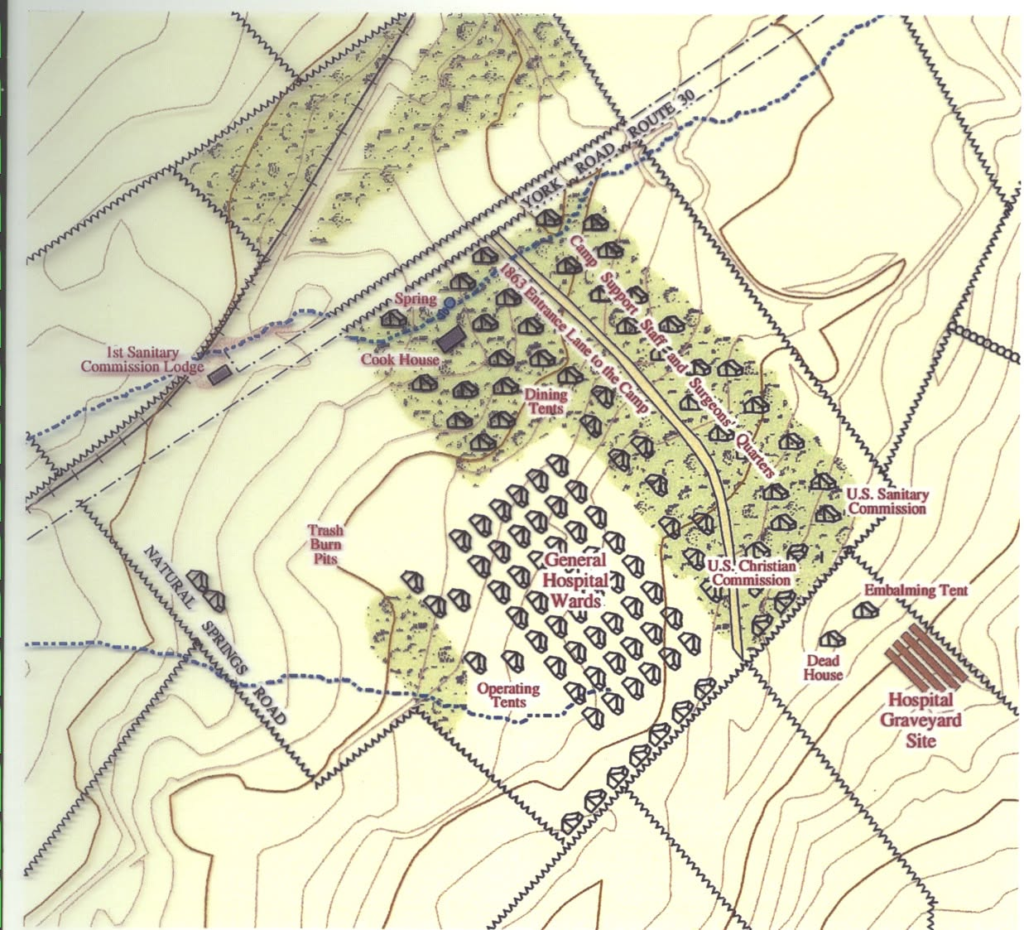
Dr. Jonathon Letterman established a general hospital here at the historic Wolf’s Farm east of downtown. He wanted the hospital here because of the closeness to York Road, the Gettysburg Railroad, and it was one of the higher locations around the area. This area had a good spring that provided lots of water. As the hospital was started, hundreds of tents, drainage ditches, cooking supplies, and facilities for surgeons, nurses, and surgery were installed and brought in to help wounded or mortally wounded soldiers.
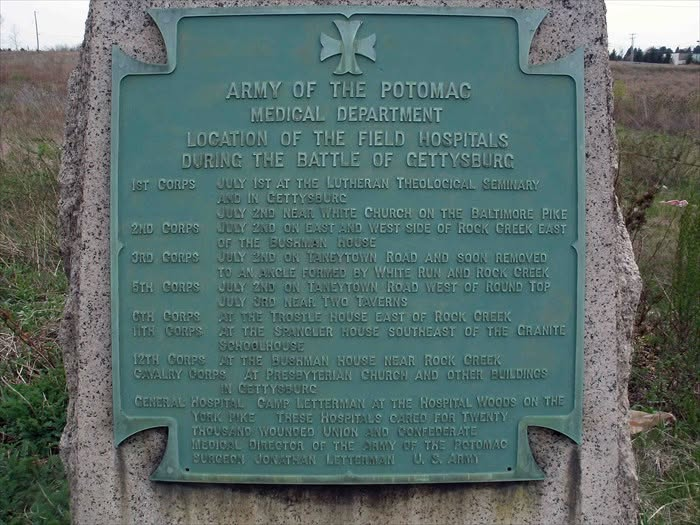
This plaque below shows the location of field hospitals during the battle of Gettysburg for each Corps. Each one was moved that was North and West of the town as Confederate soldiers occupied that region. Some field hospitals are near regimental monuments that provided care and took care of injuries near Rose Woods and the Wheatfield.
On July 5th, two days after the battle of Gettysburg, Union soldiers with the Federal army moved away from town in chase of the Confederate army. However, the Union army left 100 surgeons, 6 ambulances, 4 wagons per Corps, and their goal was to move approximately 800 soldiers a day out of Gettysburg. This hospital was closed the day after Lincoln arrived into Gettysburg and gave the Gettysburg Address on November 20, 1863.
Here is a zoomed in map from a survey that was taken after the Battle of Gettysburg in 1868-1870. There is much detail in this map, so let’s explore some things. North of the railroad tracks, Penn. College is now what is Gettysburg College.
There are also three roads that lead north of Gettysburg in a form of a triangle:
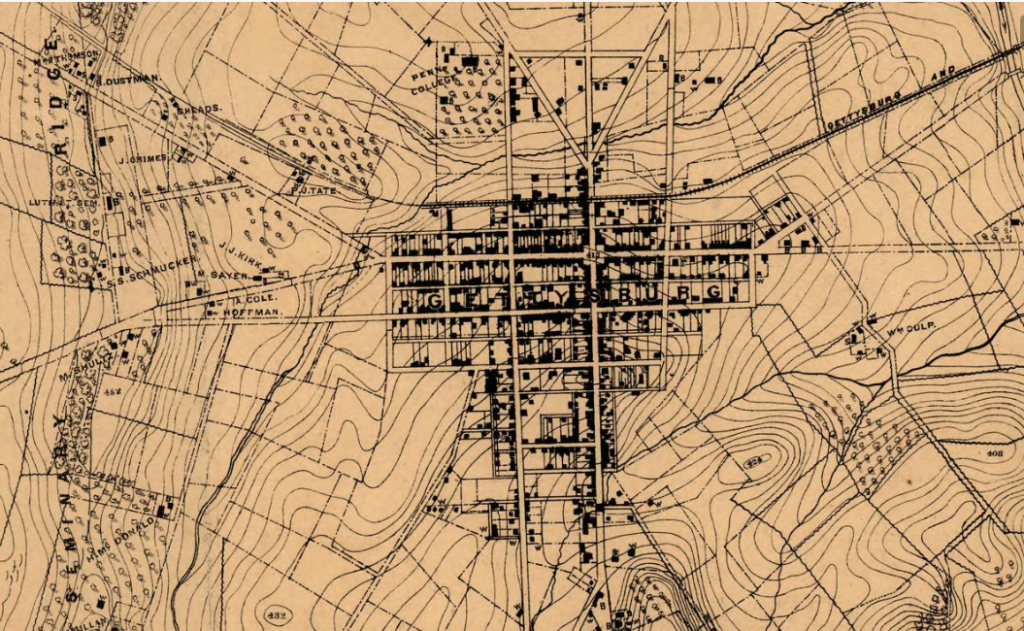
There are two roads that lead west of town:
There are two roads that lead south of town:
There is one road that leads east of town: York Road
These roads from the north and the west brought in supplies and soldiers from the Confederacy, while the southern roads will supply the Union army.
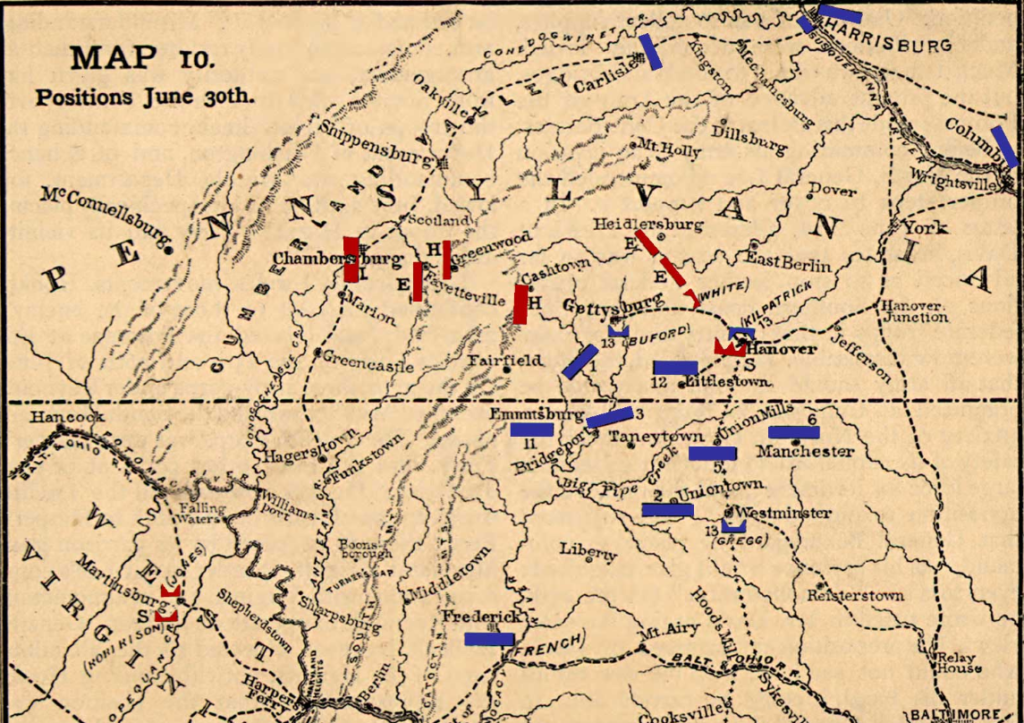
This map shows the location of the Union Corps and the Confederate forces around Gettysburg. This will provide beneficial aspects with the Union forces concentrated in a small general area to reinforce battle lines in a short amount of time. Confederate forces had to walk from Chambersburg to Gettysburg. What a journey they had on muddy roads, the heat and humidity, and the lack of water.