
President Abraham Lincoln arrived into Gettysburg on the evening of November 18th, 1863. He was feeling ill and stayed inside for much of the evening. His young son, Tad, and his wife Mary stayed behind at the White House since Tad was recovering from smallpox. It is said that Lincoln may have had the illness as well.
During the remainder of the evening, Lincoln made the speech better and may have changed something about the Gettysburg Address. The first page of the Address is on White House stationary and the second page was on some paper that David Wills obtained for him to use. President Lincoln received a message from the White House that Tad Lincoln was sick, but was feeling better.
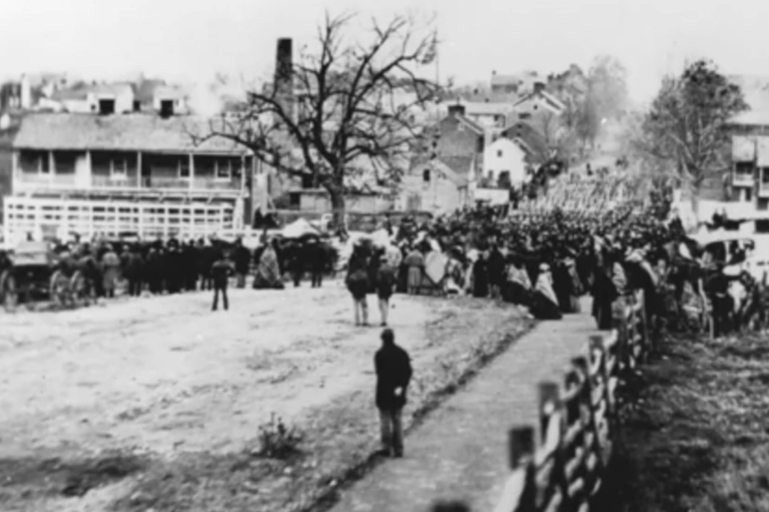
President Lincoln didn’t tour the battlefield prior to the Gettysburg Address. He would have had viewed some of the battlefield as he rode up on a horse within a procession riding up from the David Wills House to the Soldiers National Cemetery. Lincoln would have his collogues around him and behind him would have thousands of civilians and citizens following him up Baltimore Street. The procession would have went down Baltimore Street, then right onto Steinwehr Avenue and then left onto Taneytown Road. This is when President Lincoln and the other speakers would have then spoke at the speakers platform. Edward Everett spoke for two hours while civilians waited in the chilly temperatures waiting for Abraham Lincoln to speak.
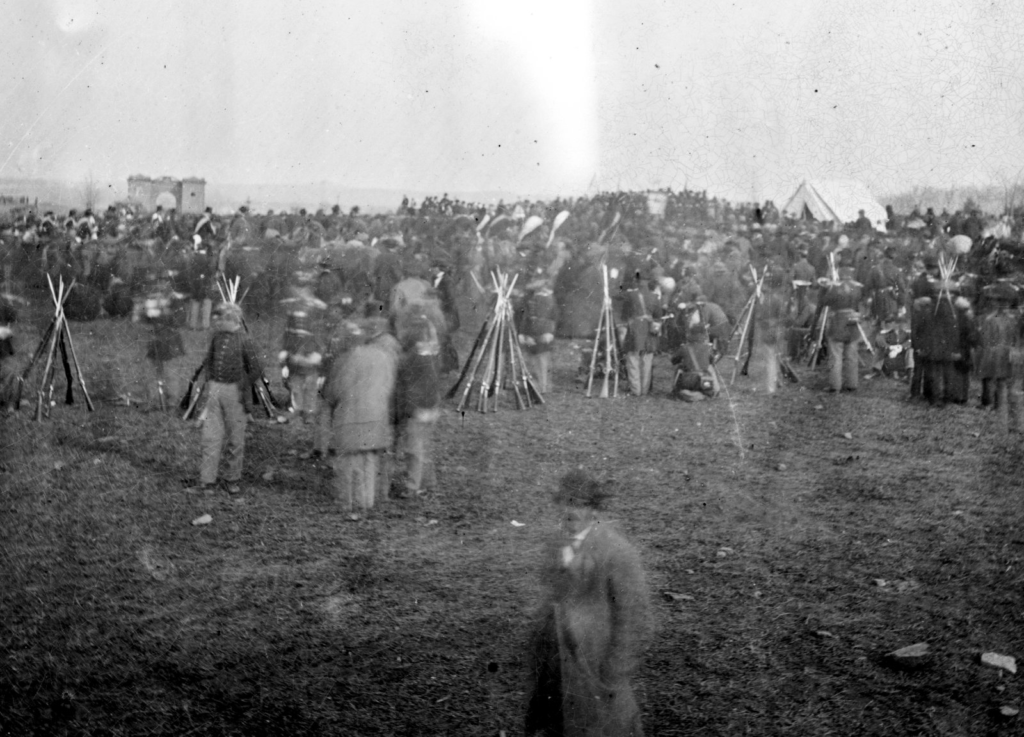
Lincoln took the stage and spoke one of the most famous speeches of American History:
“Four score and seven years ago our fathers brought forth on this continent, a new nation, conceived in Liberty, and dedicated to the proposition that all men are created equal.
Now we are engaged in a great civil war, testing whether that nation, or any nation so conceived and so dedicated, can long endure. We are met on a great battle-field of that war. We have come to dedicate a portion of that field, as a final resting place for those who here gave their lives that that nation might live. It is altogether fitting and proper that we should do this.
But, in a larger sense, we can not dedicate – we can not consecrate – we can not hallow – this ground. The brave men, living and dead, who struggled here, have consecrated it, far above our poor power to add or detract. The world will little note, nor long remember what we say here, but it can never forget what they did here. It is for us the living, rather, to be dedicated here to the unfinished work which they who fought here have thus far so nobly advanced. It is rather for us to be here dedicated to the great task remaining before us – that from these honored dead we take increased devotion to that cause for which they gave the last full measure of devotion – that we here highly resolve that these dead shall not have died in vain – that this nation, under God, shall have a new birth of freedom – and that government of the people, by the people, for the people, shall not perish from the earth.”
After the ceremony, Lincoln and the rest of the dignitaries returned back to the David Wills House for lunch. After lunch, he was invited to the Presbyterian Church for a political rally where he met with the hero of Gettysburg, John Burns. President Lincoln then left Gettysburg around 7 p.m. on November 19th on the train back to Washington D.C. In total, Lincoln was in Gettysburg, his only visit to the town where the battle occurred for a 25-hour period. In that time, he spoke from the heart and gave his true vision of what this place met to him as well as to the rest of the nation.