Skip to content

Gettysburg Chronicles

History Explained

  • Home
  • Gettysburg
    • History of Adams County
    • Samuel Gettys
    • Call to Arms
    • Days Before The Battle
  • Tales to War
    • July 5th: Tillie Pierce Tale
    • 57th Pa.: Letter to Mother
    • 24th Mich.: Abel Peck
    • 24th Mich.: Charles Bellore
    • 1st Rifles: Colonel Taylor
    • 7th Mich.: Allen Zacharias
    • 1st Michigan: Amos Ladd
  • Confederate
    • South Carolina
    • Mississippi Monuments
    • Florida’s Involvement
    • Spirit of Alabama
    • Georgia – The Peach State
    • Louisiana Secedes
    • Lonestar State
    • North Carolina
    • Virginia Secedes
    • Arkansas
    • Tennessee – Last to Join
    • Maryland – Border State
  • Union
    • First Shot Marker
  • Michigan
    • Michigan Cavalry
    • Farnsworth’s Cavalry
    • 9th Michigan Battery
    • 7th Michigan Infantry
    • 24th Joins Iron Brigade
      • 24th Before Fredericksburg
      • 24th Mich. to Gettysburg
      • 24th Michigan – July 1st
      • 24th Michigan Losses
    • 1st Michigan Infantry
      • 1st Michigan Arrives
      • Michigan Pulls Back
      • First Michigan
    • 3rd Michigan
      • Lost soldiers of the 3rd
    • 4th Michigan
      • Harrison Jeffords
      • Defending the Flag
      • Lost Wolverines
  • Artillery
    • Different Ammunition
    • Real vs. Fake Cannons
    • Six Pound Shot Cannon
    • Cannons at Devil’s Den
    • Rochester Union Grays
    • Fallen Rochester Grays
  • Civil War Locations
    • Crampton’s Gap, Md.
    • Fox’s Gap, Md.
    • Turner’s Gap, Md.
    • Andersonville, Ga.
    • Navy – Hampton Roads, Va.
  • Photographs
  • Abraham Lincoln
    • Lincoln Visits Antietam
    • Emancipation Proclamation
    • November 1863
    • Gettysburg Address
    • John Wilkes Booth
    • The Kidnapping Plan
    • Ford’s Theatre
    • Death of Abraham Lincoln
    • Death of an Actor
    • Tribunal Results
  • Lost Commanders
    • Stonewall Jackson
      • Spring of 1862
      • Fall of 1862
      • Winter of 1862
      • Family
      • Life After Stonewall
      • Descendants of Jackson
      • Stonewall’s Grandson Tree
    • John F. Reynolds
      • California Love
      • Reynolds Arrives
      • Morning of July 1st
      • July 1st to July 3rd
      • Ms. Mary “Kate” Hewitt
      • Daughters of Charity
  • Anniversaries
    • Battlefield Walks
    • 150th Anniversary – 2013
    • 152nd Anniversary – 2015
    • 157th Anniversary – 2020
    • 158th Anniversary – 2021
    • 162nd Anniversary – 2025
    • 163rd Anniversary – 2026
    • Scorching Heat – 2026
  • Buildings
    • Cashtown
      • July 1863 in Cashtown
      • Cashtown: Since 1863
    • Soldier’s Orphanage
      • Brickyard Fight
      • 154th New York
      • Amos Humiston
      • Rosa Carmichael
    • Houses of the Wades
    • Field Hospitals
      • St. Francis Xavier Church
      • St. James Lutheran Church
    • The House on the Hill
      • Louisiana Tigers
    • Sach’s Bridge
    • Weikert Family Farms
    • Welty House
    • Farnsworth House
    • Winebrenner History
  • Railroads
    • G&H Railroad
    • Western Maryland Railroad
    • Location of the Spur
    • Gettysburg Electric Trolley
    • Trolley South of Town
    • Railroad to Round-Tops
  • Paranormal
    • Paranormal Equipment
    • Spirits at the Cashtown Inn
    • Pictures on the Bridge
    • Live: Sachs Covered Bridge
    • Haunted Orphanage
    • McClellan’s Duplex Kitchen
    • Spirits at the Farnsworth
    • Spirits at Tillie Pierce Inn
  • Wade Family
    • Thaddeus Filby
    • Rise of the Captain
    • Trouble with the Law
    • Jennie Wade
    • Newspaper Articles
    • Gravesites of Jennie Wade
    • Samuel and Harry Wade
    • James John “Jack” Wade
  • Georgeanna McClellan
    • Extended McClellan’s
    • Iowa Family – Lewis
    • World War II POW
    • Jennie Wade McClellan
    • Nellie McClellan
    • John McClellan
  • Jim B. McClellan
    • Georgia W. McClellan
      • Dallas Schwarzenbach
        • Children of Dallas
        • Donald Schwarzenbach
    • Nellie Glady McClellan
    • Mary Wade McClellan
    • Martha B. McClellan
      • Sarah Isobel Holland
      • Martha’s Other Children
      • Glady Elizabeth Holland
    • Beese Everyln McClellan
    • Sons of Jim Britton
    • Military Ancestors
  • Families
    • Thorns
      • Evergreen Cemetery: August 1862 to June 1863
      • Gettysburg: June 26, 1863
      • Evergreen Gatehouse
      • Thorn’s Family Tree
      • Descendants of the Thorns
      • Aftermath of Battle
      • Thorn Important Locations
    • Pierce Lineage
      • McCurdy to Pierce Tree
      • James Shaw Pierce
      • William H. Pierce
      • Tillie Pierce
        • Last Week of June 1863
        • Tillie’s Accounts – July 1st
        • Wounded Everywhere
        • Hospital – Pierce House
        • Alleman’s Family
    • Garlach Family
      • Soldier Hiding with Pigs
      • Anna Garlach
    • Shriver Family
      • Weikert’s Connection
      • Union Calvary Disaster
      • Father’s Death
      • Henrietta’s New Life
    • Leister Family Origins
      • Lydia Study Leister
      • July 1st – Lydia’s Home
      • Leister’s House
  • Questions
  • Toggle search form

Category: Confederate

June 29th, 1863

Posted on June 28, 2026August 10, 2026 By BD No Comments on June 29th, 1863

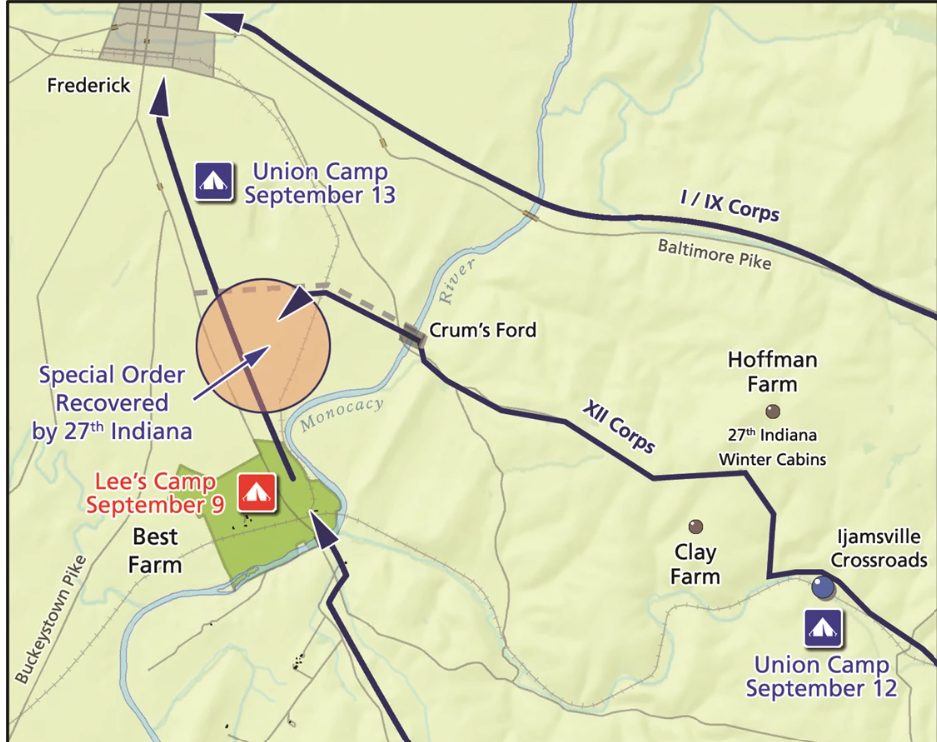
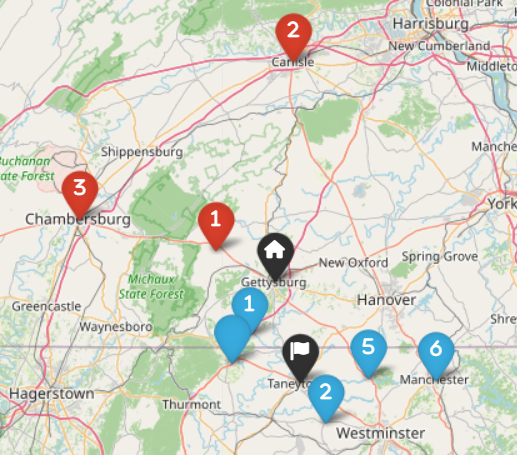
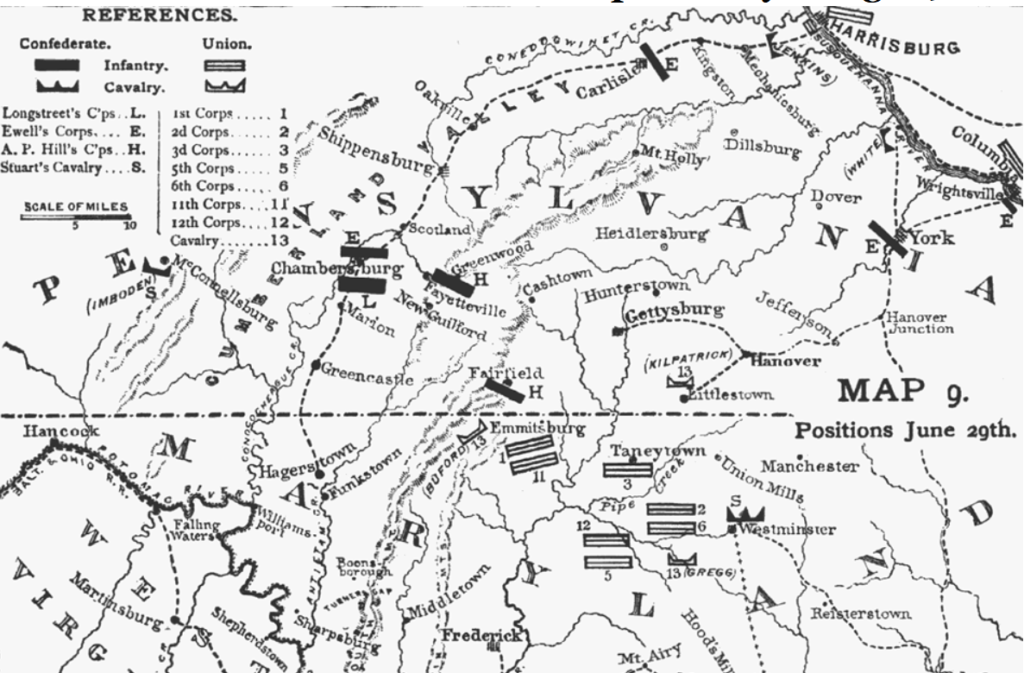
The locations of the Confederate and Union Corps on June 29th. However, that’s not the main story. The temperatures are brutal across the Mid-Atlantic ranging between 90 to 100 degrees and evening thunderstorms with the heat. With traveling on muddy and backroads, it was a very difficult to travel from one place to another.

Meanwhile, the Confederate forces were spread out across Pennsylvania, but had plenty of access roads to combine forces if need be. The 1st Corps was in Chambersburg and commanded by Lieutenant General James Longstreet. The 2nd Corps was in Carlisle and was commanded by Lieutenant General Robert S. Ewell, and the 3rd Corps was commanded by Lieutenant General Ambrose Hill that was stationed outside Cashtown.

Here are some of the distances that the Union Corps had to march on June 29th.

  • 1st and 11th Corps (blank icon) marched from Frederick to Emmitsburg – 23 miles
  • 2nd Corps marched from Monocacy to Uniontown – 26 miles
  • 3rd Corps marched from Woodsborough to Taneytown – 12 miles
  • 5th Corps marched from Frederick to Libertytown – 11 miles
  • 6th Corps marched from Hyattstown to New Windsor – 26 miles
  • 12th Corps marched from Taneytown to Frederick – 23 miles
  • Bufford’s Cavalry rode from Middletown to Fairfied – 8 miles
  • Gregg’s Cavalry rode from New Market to New Windsor – 21 miles
  • Kilpatrick’s Cavalry rode from Frederick to Littlestown – 31 miles

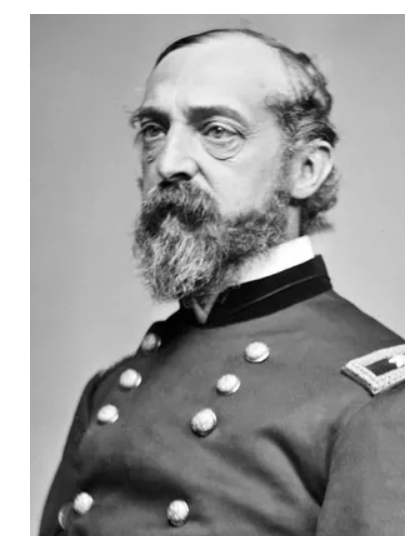
Newly appointed general of the Union Federal Army was Major General George Gordon Meade. He wanted the Union army to deploy between Middlestown to Taneytown to Manchester. He wanted to have strong fallback positions in northern Maryland. He wanted to protect Washington D.C. and Baltimore, and wanted to defend Mary-land, not Pennsylvania.

Confederate, Gettysburg, President, Union, Wade Family

June 27, 1863

Posted on June 28, 2026August 10, 2026 By BD No Comments on June 27, 1863

The battle of Gettysburg is less than a week away. However, it’s only been less than 24 hours since Major General George Gordon Meade received orders that he is now the commander of the Army of the Potomac. Meade then directs and informs Major General Joseph Hooker of his relief from command.

George Gordon Meade is now the 5th man to command the Army of the Potomac in less than a year. General Meade learns that the Confederates are in southern Pennsylvania ransacking communities and terrifying citizens on the frontier. He commands the Union army to slowly drift north to see if they can draw the Rebels to fight them in Mary-land.

Courtesy of the novel – Battles and Leaders of the Civil War: III: Retreat from Gettysburg, page 266

His orders are to keep the Union army protecting Washington D.C. from the Confederates to the North.

Artillery, Confederate, Gettysburg, President, Railroad Maps, Union

June 26th, 1863

Posted on June 25, 2026August 10, 2026 By BD No Comments on June 26th, 1863

A cold rain fell as Confederate soldiers of Early’s men march towards Gettysburg in search of “shoes”. Really, all they wanted was shoes? Ha! Anyways, they approached the town from the west and soon spotted raw Union recruits near Knoxlyn’s Ridge. The 26th Pennsylvania Emergency Militia was commanded by Col. William Jennings. He was a young 24 year old soldier commanding the militia.

Private George Washington Sandoe

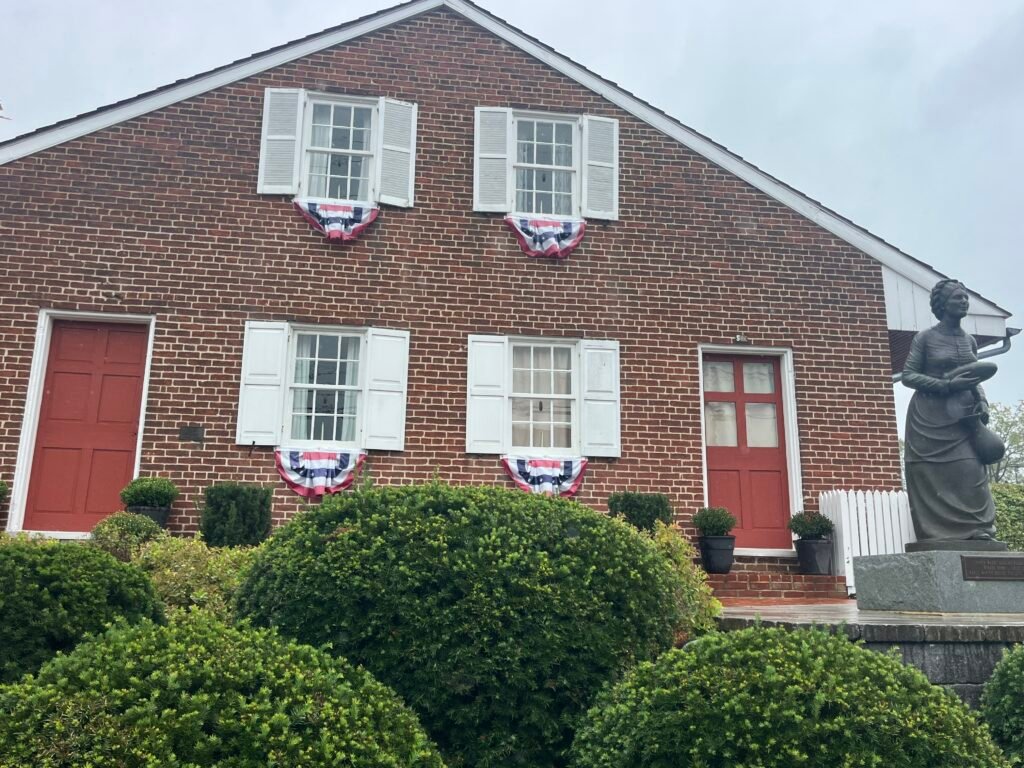
A local cavalry unit commanded by Capt. Robert Bell’s Adams County Cavalry Company comprised of 50 locals. After being dismissed by Bell to evade capture from the approaching Confederates, Private George Washington Sandoe and William Lightner ride past Georgia’s House ( The Jennie Wade House ) and the Evergreen Cemetery and towards Rock Creek on Baltimore Pike around 4pm. Sandoe fell and dies after being shot off his horse by the Rebels. Sandoe is often referred to the first Federal casualty at Gettysburg. The Confederates takes his horse and rides back to town.

Courtesy of Vivian Marsh and Willie on Find a Grave – Louis Kenneth McClellan and Georgia Wade McClellan

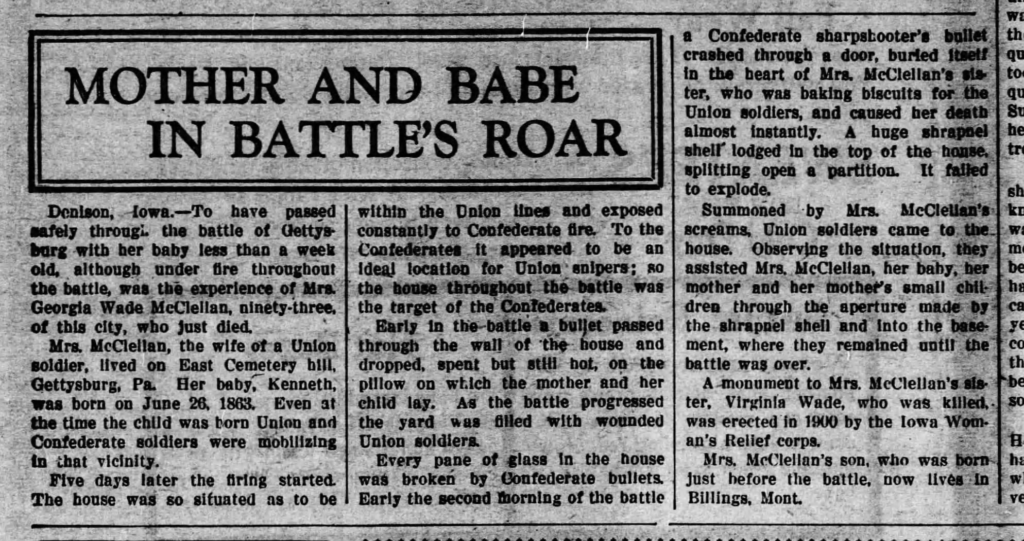
Earlier that day, around 2:30 p.m., about an hour before the Confederates rode past in chase of Private Sandoe and Private Lightner, Georgia Wade McClellan gave birth to her first son, Louis Kenneth McClellan.

Peter and Elizabeth Thorn

Meanwhile, after Sandoe was killed, the Confederates in the chase stopped at the Evergreen Cemetery. They asked for food and water from the caretaker of the cemetery. Mrs. Elizabeth Thorn, who was 6 months pregnant, serves the enemy their food and they disappear into night.

Confederate, Evergreen Cemetery, Gettysburg, Jennie Wade, Union

June 21, 1863 – Upperville

Posted on June 21, 2026August 10, 2026 By BD No Comments on June 21, 1863 – Upperville

On the frontier of Virginia, Confederate and Union soldiers clashed near Upperville. In the midst of the Gettysburg Campaign, the Union were trying to figure out what the Confederates next move was. Over the following six weeks, there has been a drought across the Mid-Atlantic. On June 19th, a heavy rainstorm soaked the valley. During the downpour, Confederate cavalry was deployed near the Ashby Gap Turnpike.

Courtesy of the American Battlefield Trust

However, Union cavalry commander Alfred Pleasonton had asked for reinforcements to support him and the battle that would ensue. He was granted some infantry support from General George Meade’s 5th Corps. Colonel Strong Vincent’s brigade along with another cavalry division was in reserve. On this morning, Union cavalry was held back from Confederate forces under J.E.B. Stuart that were hidden behind stone walls and steep slopes near the creek. However, as Union soldiers within the reserve pushed forward, the Confederates started to falter. Here at Goose Creek, the Confederates held for approximately two hours before the 16th Michigan arrived.

Overall, there was no real advantage here at Upperville on who won the small skirmish. However, around 200 soldiers of the Union and 175 of the Confederacy was wounded in this attack.

Artillery, Confederate, Gettysburg, Union

Death of the General

Posted on May 10, 2026May 13, 2026 By BD No Comments on Death of the General

After the amputation of his left arm on the early morning of Mary 3rd, he was moved to the Chancellor’s House on May4th. Mary Ann Jackson was alerted of her husband’s amputation and made arrangements to come to see her husband and nurse him. Reverend Lacy arrived on May 5th and read bible versus to Stonewall Jackson. Mrs. Jackson arrived on May 7th to help around the small house and talk to her husband as he rested after his surgery.

On Friday, May 8th, Stonewall Jackson’s health took a turn for the worse as he fell into pneumonia. Reverend Lacy continued to spend time in vigil while the staff that served Jackson for the last two years helps Mrs. Jackson. On Sunday, May 10th, Dr. McGuire informs everyone that Stonewall will pass away sometime today. Mrs. Jackson spends time with Thomas Jackson as he opens his eyes and slowly takes and whispers with his wife. Stonewall mentions that he’d like to be buried in his family plot in Lexington, Virginia.

Courtesy of the Author at Arlington National Cemetery in 2013

Around 1 p.m., Stonewall slowly whispers the following statement: ” It is the Lord’s day, my wish is fulfilled and have always desired to die on his day.” A few hours later around 3:15 p.m., he opens his eyes wide and starts talking in phrases: “Let us cross over the river, and rest under the shade of the trees”. Thomas Stonewall Jackson peacefully closes his eyes and dies on the bed with his wife and staff surrounding the bed.

This picture above is from Arlington National Cemetery in 2013 when I visited it. It shows a small river in the “shade of the trees” within the cemetery. It shows thousands of graves of soldiers that crossed over the river to heaven. It is a fitting tribute to a great general that served his soldiers, his family, and his faith.

Confederate, Gettysburg

Battle of Chancellorsville

Posted on May 2, 2026August 10, 2026 By BD No Comments on Battle of Chancellorsville

This battle that occurred in Virginia was considered one of General Robert E. Lee’s greatest battles. According to the historians, this was the fifth deadliest battle of the Civil War. However, even though this battle was a complete success against the Union, it came with a cost. General Stonewall Jackson, Lee’s right hand man, was mortally wounded by friendly fire on the evening of May 2nd.

Overall at Chancellorsville, the Union army had around 97,000 soldiers with 1700 being killed, 9700 wounded, and 6000 soldiers were missing. On the other hand, the Confederates had around 57,000 soldiers, approximately 1725 killed, 9200 wounded, and 2500 missing. Across this battlefield, there is more signage and wayside markers than monuments.

The grand plan that Lee and Jackson developed was to attack the Union’s right flank. Lee had approximately 13,000 soldiers and a huge artillery battalion, while Jackson had nearly 28,000 soldiers and had to march twelve miles out of view behind the Union lines.

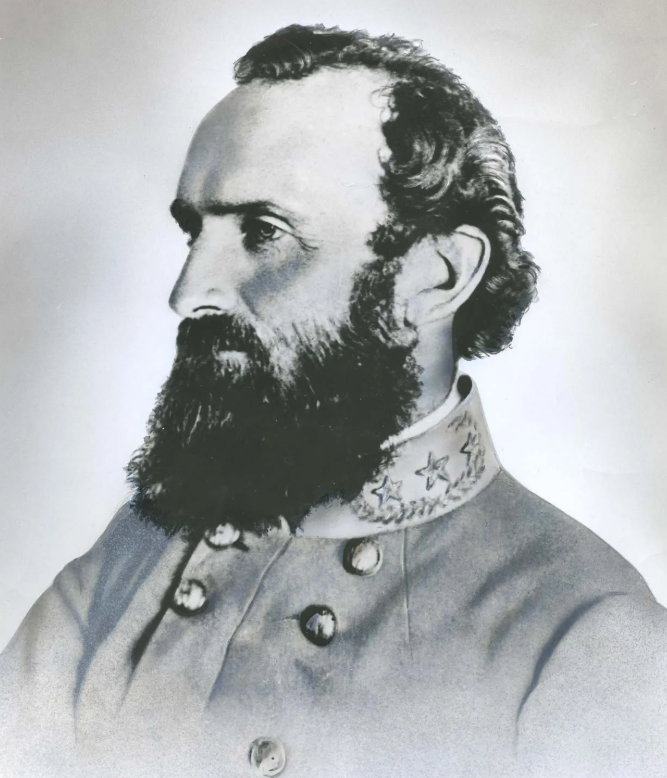
Confederate General Thomas “Stonewall” Jackson portrait taken at Nathaniel Routzahn’s photography gallery in Winchester in November 1862.

The attack began around 5 p.m. on the afternoon of May 2nd and attacked the 11th Corps, which was commanded by Union General Oliver O. Howard. As I have mentioned within the first day battle in Gettysburg, the 11th Corps were called the “Flying Dutchmen”. This is where they obtained that nickname. The 11th Corps were surprised attacked by the Confederates and fled more than 2 miles before General Hooker dug in and awaited the Confederates near the Chancellor’s House.

His amputated arm is buried at Ellwood Manor, Virginia

Darkness fell and around 8 p.m. General Stonewall Jackson and his commanders on horseback were possibly near enemy lines. They were unsure about their location of their troops and the enemy. The 33rd North Carolina skirmish line fires into the group. Jackson is hit three times: one in the right hand, the second in the left shoulder blade, and the other in the left elbow. Jackson’s horse runs off and Jackson is put into a stretcher and taken to a field hospital. During the shooting and the field hospital, Jackson would fall off the stretcher three times, and have bandages on his shoulder and elbow. His own physician, Hunter McGuire, would see Jackson in the field hospital. On the morning of May 3rd, his left arm was amputated. From the bullet that was taken out of his amputated arm, it was a smooth-bore bullet, which came from the 33rd North Carolina regiment. Around the same time, General Robert E. Lee learns that Stonewall Jackson was shot.

Robert E. Lee was quoted as saying, “He has lost his left arm, but I have lost my right.”

Artillery, Confederate, Gettysburg, McClellan, President, Union

January 1861

Posted on January 31, 2026February 3, 2026 By BD

This month was the start of the creation of the majority of the states beginning to come together to join as the Confederate States of America 165 years ago. By February 1st, the states in order would have seceded from the Union. The Confederate flag below was mainly used between 1861 and 1863, prior to the stainless banner with the crossed rails. The following states that seceded are:

South Carolina, Mississippi, Florida, Alabama, Georgia, Louisiana, and Texas.

Confederate
  • Battlefield Map
  • Gettysburg Museums & Hotels
  • Union History
  • Confederate History
  • Author's History
  • August 2026
  • July 2026
  • June 2026
  • May 2026
  • April 2026
  • March 2026
  • February 2026
  • January 2026

Recent Posts

  • Search for Food
  • 3rd Michigan
  • 1st Michigan – August 1861
  • Three Month Regiment – 1st Michigan
  • Camp Letterman

Recent Comments

No comments to show.

@ 2026 Gettysburg Chronicles

Powered by PressBook WordPress theme