
This battery in Michigan was one of the first responses to Lincoln’s call for three-year volunteers in July 1862. These soldiers, all 168 officers and soldiers, were mostly from Lenawee County, Michigan. Of all of these soldiers, Jabez J. Daniels was appointed Captain. This regiment was raised with the 5th Michigan Cavalry. Separate from previous regiments that left Detroit in September 1861, the battery departed on December 4th from Detroit with four Parrott Rifles and two Howitzers. This was also called 1st Michigan Light, Battery I. They arrived into Washington D.C. on December 11th, 1862.
After a few weeks of training with the 5th Michigan Cavalry and firing their cannons in unison, the battery saw its first action at the Battle of Aldie on April 27, 1863, with no wounded or casualities. After the battle, they returned to the Fairfax Court House. When the Gettysburg Campaign began on June 3rd, they marched from the Fairfax Court House northward to Frederick and Taneytown, Maryland, and arrived late on the evening of July 2nd at Gettysburg.
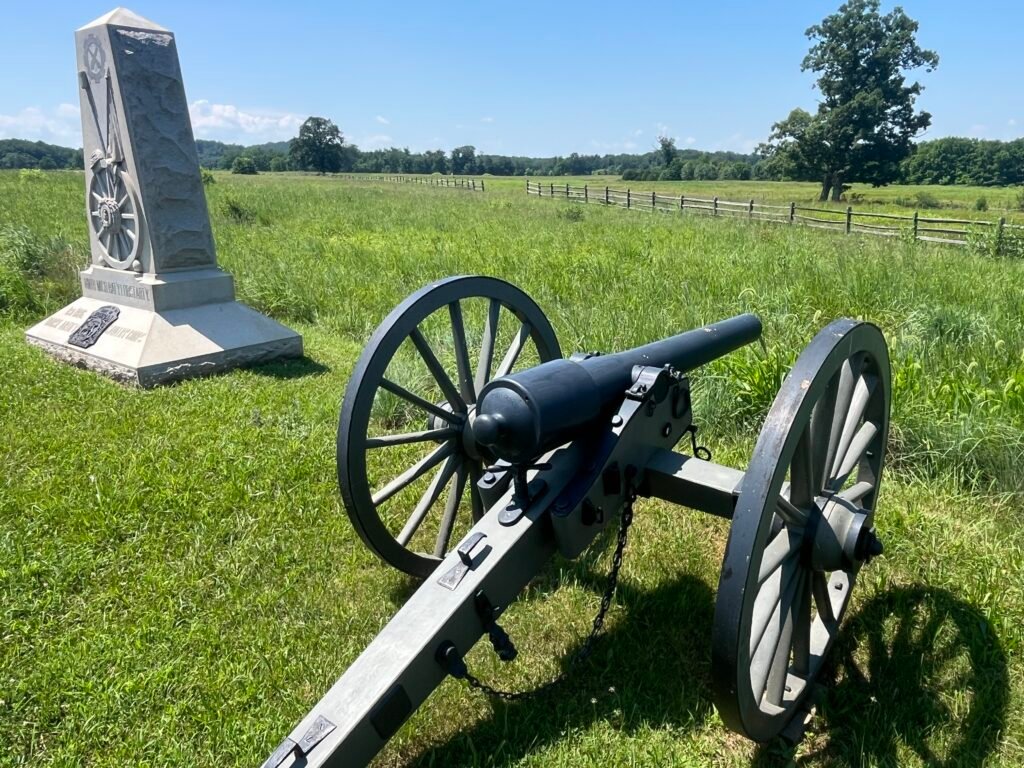
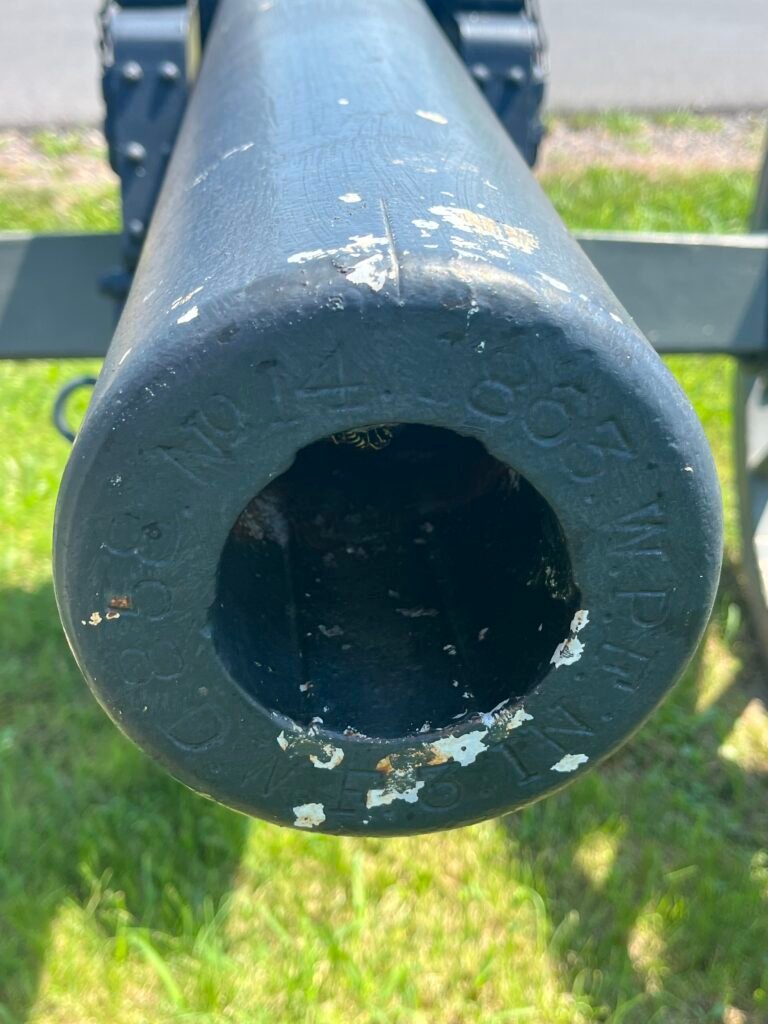
This is one of the Parrott Cannons that is associated with the 9th Michigan monument. This picture below shows that this is a “real” cannon that rests on the battlefield. You can see the “rifle” grooves in the cannon tube. This cannon shows the following information:
- Number #14
- Cannon was created in the West Point Foundry (WPF) in 1863
- 858 pound cannon barrel
- The Cannon was approved by D.F.W.
When looking at cannons, be careful of the things that could live or reside in the barrel of the cannon tube. In this one, there was a nest of hornets. Other tubes have had nests of birds.
The 9th Michigan fought here on July 3rd, and one soldier was killed, along with four other causalities within the battery. During the battle, over 300 shot, shell, and canister shells were used to fight off the Confederacy. This monument was dedicated in 1888, on the 25th anniversary of the battle. If you look closely at the monument, it carries a lot of different pieces to a cannon. There’s a rammer that is connected with the cannon, along with an artillery wheel, cannon balls, and a soldier’s kepi on top of the wheel.
The Battle of Aldie and Gettysburg were the only battles that the 9th Michigan fought at within the Eastern Theatre. The rest of their battles occurred in Georgia.