
Skip to content

Gettysburg Chronicles

History Explained

  • Home
  • History of Gettysburg
    • History of Adams County
    • Samuel Gettys
    • Call to Arms
    • Days Before The Battle
  • Tales of War
    • Photographs
    • July 5th: Tillie Pierce Tale
    • 57th Pa.: Letter to Mother
    • 24th Mich.: Abel Peck
    • 24th Mich.: Charles Bellore
    • 1st Rifles: Colonel Taylor
    • 7th Mich.: Allen Zacharias
    • 1st Mich.: Amos Ladd
  • Monuments & Artillery
    • First Shot Marker
    • Artillery
      • Different Ammunition
      • Real vs. Fake Cannons
      • Six Pound Shot Cannon
      • Cannons at Devil’s Den
      • Rochester Union Grays
      • Fallen Rochester Grays
    • Michigan
      • 24th Joins Iron Brigade
        • 24th Before Fredericksburg
        • 24th Mich. to Gettysburg
        • 24th Michigan – July 1st
        • 24th Michigan Losses
      • 1st Michigan Infantry
        • 1st Michigan Arrives
        • Michigan Pulls Back
        • First Michigan
      • 3rd Michigan
        • Lost soldiers of the 3rd
      • 4th Michigan
        • Harrison Jeffords
        • Defending the Flag
        • Lost Wolverines
      • Michigan Cavalry
      • Farnsworth’s Cavalry
      • 9th Michigan Battery
      • 7th Michigan Infantry
    • Confederate
      • South Carolina
      • Mississippi Monuments
      • Florida’s Involvement
      • Spirit of Alabama
      • Louisiana Secedes
      • Lonestar State
      • North Carolina
      • Virginia Secedes
      • Arkansas
      • Tennessee – Last to Join
      • Maryland – Border State
      • Georgia – The Peach State
  • Lost Commanders
    • Abraham Lincoln
      • Lincoln Visits Antietam
      • Emancipation Proclamation
      • November 1863
      • Gettysburg Address
      • John Wilkes Booth
      • The Kidnapping Plan
      • Ford’s Theatre
      • Death of Abraham Lincoln
      • Death of an Actor
      • Tribunal Results
    • Stonewall Jackson
      • Spring of 1862
      • Fall of 1862
      • Winter of 1862
      • Family
      • Life After Stonewall
      • Descendants of Jackson
      • Stonewall’s Grandson Tree
    • John F. Reynolds
      • California Love
      • Reynolds Arrives
      • Morning of July 1st
      • July 1st to July 3rd
      • Ms. Mary “Kate” Hewitt
      • Daughters of Charity
  • Lincoln in Gettysburg
    • Lincoln Leaves Washington
    • Hanover Junction
    • Lincoln Arrives in Town
    • Parade Route to Cemetery
    • Gettysburg Address
    • Soldier’s National Cemetery
  • Railroads
    • G&H Railroad
    • Western Maryland Railroad
    • Location of the Spur
    • Gettysburg Electric Trolley
    • Trolley South of Town
    • Railroad to Round-Tops
  • Anniversaries
    • Battlefield Walks
    • 150th Anniversary – 2013
    • 152nd Anniversary – 2015
    • 157th Anniversary – 2020
    • 158th Anniversary – 2021
    • 162nd Anniversary – 2025
    • 163rd Anniversary – 2026
    • Scorching Heat – 2026
  • Other Battles
    • Crampton’s Gap, Md.
    • Fox’s Gap, Md.
    • Turner’s Gap, Md.
    • Andersonville, Ga.
    • Navy – Hampton Roads, Va.
  • Families
    • Wade’s Lineage
      • Thaddeus Filby
      • Rise of the Captain
      • Trouble with the Law
      • Jennie Wade
      • Newspaper Articles
      • Gravesites of Jennie Wade
      • Samuel and Harry Wade
      • James John “Jack” Wade
    • Georgeanna McClellan
      • Extended McClellan’s
      • Iowa Family – Lewis
      • World War II POW
      • Jennie Wade McClellan
      • Nellie McClellan
      • John McClellan
    • Jim B. McClellan
      • Georgia W. McClellan
      • Dallas Schwarzenbach
      • Schwarzenbach’s Children
      • Donald Schwarzenbach
      • Nellie Glady McClellan
      • Mary Wade McClellan
      • Martha McClellan and Children
      • Sarah Isobel Holland
      • Glady Elizabeth Holland
      • Beese Everyln McClellan
      • Sons of Jim Britton
      • Military Ancestors
    • Thorn’s Lineage
      • Evergreen Cemetery: August 1862 to June 1863
      • Gettysburg: June 26, 1863
      • Evergreen Gatehouse
      • Thorn’s Family Tree
      • Descendants of the Thorns
      • Aftermath of Battle
      • Thorn Important Locations
    • Pierce Lineage
      • McCurdy to Pierce Tree
      • James Shaw Pierce
      • William H. Pierce
      • Tillie Pierce
        • Last Week of June 1863
        • Tillie’s Accounts – July 1st
        • Wounded Everywhere
        • Hospital – Pierce House
        • Alleman’s Family
    • Garlach’s Lineage
      • Soldier Hiding with Pigs
      • Anna Garlach
    • Shriver’s Lineage
      • Weikert’s Connection
      • Union Calvary Disaster
      • Father’s Death
      • Henrietta’s New Life
    • Leister’s Lineage
      • Lydia Study Leister
      • July 1st – Lydia’s Home
      • Leister’s House
    • Dobbin’s Lineage
      • Dobbin’s Owns House
      • Miller’s Legacy
      • Brother vs. Brother
      • Snyder’s Legacy
  • Buildings
    • Cashtown
      • July 1863 in Cashtown
      • Cashtown: Since 1863
    • Soldier’s Orphanage
      • Brickyard Fight
      • 154th New York
      • Amos Humiston
      • Rosa Carmichael
    • Houses of the Wades
    • Field Hospitals
      • St. Francis Xavier Church
      • St. James Lutheran Church
    • The House on the Hill
      • Louisiana Tigers
    • Sach’s Bridge
    • Weikert Family Farms
    • Welty House
    • Farnsworth House
    • Winebrenner History
  • Paranormal
    • Paranormal Equipment
    • Spirits at the Cashtown Inn
    • Pictures on the Bridge
    • Live: Sachs Covered Bridge
    • Haunted Orphanage
    • McClellan’s Duplex Kitchen
    • Spirits at the Farnsworth
    • Spirits at Tillie Pierce Inn
  • Photographs
    • Pioneer Lines
  • Questions
  • Toggle search form

Gettysburg Address

On the morning of the November 19th, Lincoln mentioned to his secretary that he felt dizzy. Was it because of the long trip the day before, his son’s bout with smallpox back in Washington D.C., the weather, or the uncertainty of the day’s events? On the afternoon of November 19th, the President of the United States, Abraham Lincoln, would have to sit in the cool weather on a wooden platform in Gettysburg, Pennsylvania. Lincoln was invited to give a few words of wisdom and hope for the crowds of people that had gathered. During the speech, his cabinet members noticed that he had a ghostly white color in his face, and he looked haggard and sad. Later in the evening, he was diagnosed with a mild case of smallpox on the train on the return trip to Washington D.C.

President Lincoln was not the main speech of the day. The orator that spoke ahead of Lincoln was Edward Everett. Edward was an American politician, the 15th governor of Massachusetts, and was the headliner of the dedication of the Soldier’s National Cemetery. His speech was a total of an astounding 13,607 words in length and lasted over two hours. Despite the historical length of the speech, Lincoln’s speech was only the most famous 10 sentences in length, or 271 word address.
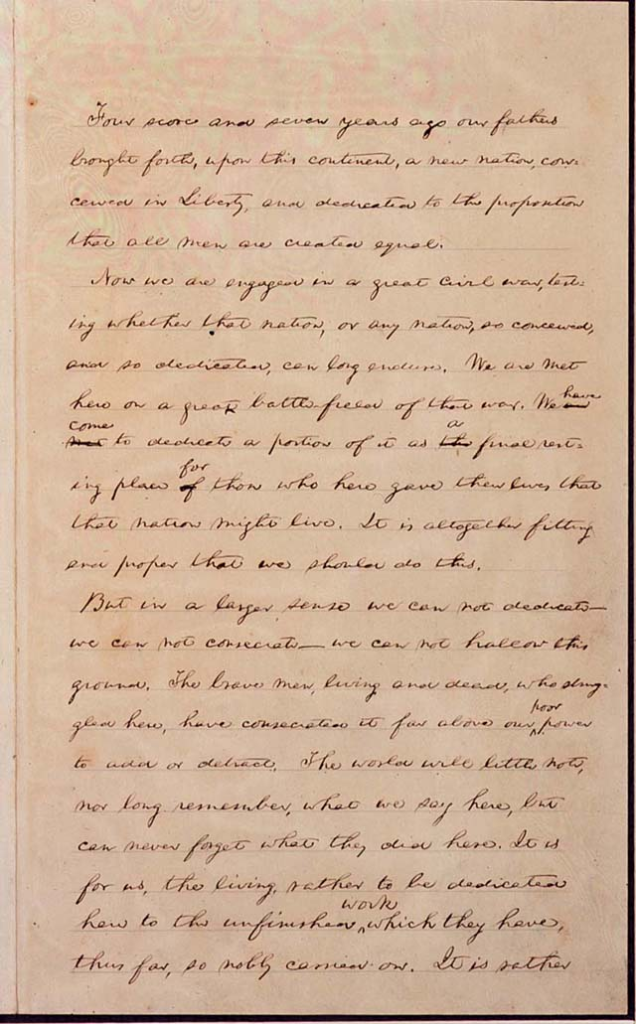
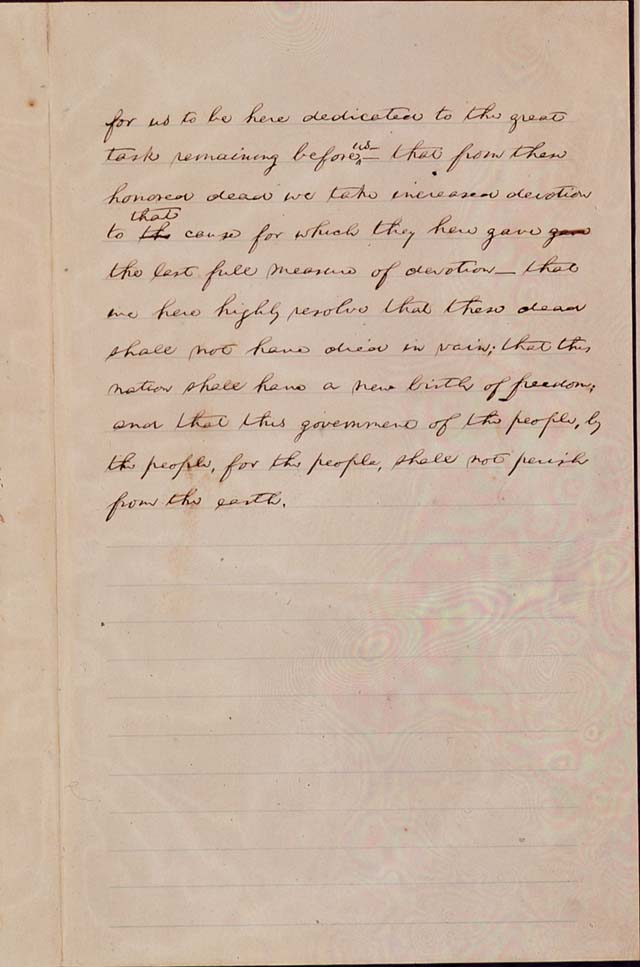
Courtesy of the Library of Congress – Gettysburg Address

President Lincoln supposedly spent time and wrote many different versions of the Gettysburg Address. They are the Bliss, Hay, Everett, and Bancroft copies. Above is the version of the Bliss copy. It is named after Colonel Alexander Bliss, stepson of historian George Bancroft, who requested a copy from President Lincoln for a soldier benefit fundraiser in 1864. It is the last known copy penned by Lincoln. 

@ 2026 Gettysburg Chronicles

Powered by PressBook WordPress theme