
The Battle of Gettysburg was still fresh on President Abraham Lincoln’s mind as the Fall of 1863 started. One of the citizens of Gettysburg had sent him a letter asking for the president to attend the dedication of the Soldier’s National Cemetery in late November. Lincoln responded that he would attend and say a few words to the gathering. He was invited by David Willis, a Gettysburg lawyer, who would provide overnight accommodations at his own household in the center of the town. The day was slated to be November 19th, 1863.

David Wills – Lawyer – Gettysburg
On November 18th, President Abraham Lincoln was needing to leave Washington D.C. and arrive in Gettysburg later that evening. His wife, Mary Lincoln, begged for him not to leave the White House since their son Thomas Tad Lincoln was sick with smallpox. Mary became hysterical after stating that she didn’t want to be home along with their son in case he would pass away. The Lincoln’s had already watched two of their sons die to diseases:
- Edward Baker Lincoln (1846 – 1850) – Tuberculosis
- William Wallace Lincoln (1850 – 1862) – Typhoid Fever
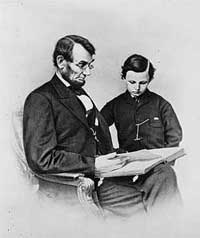
– Lincoln and Thomas Lincoln –
– February 9, 1864
However, even with this knowledge and the truth of his first two sons dying of disease, and the third having smallpox, President Abraham Lincoln refused to cancel his travel to the dedication. At Noon, Lincoln and his associates consisting of Secretary of State William Seward, Postmaster General Montgomery Blair, and the Marine Corps Band, and many newspaper correspondents left Washington D.C. on a special train that had four or five new train cars that were furnished by the Baltimore & Ohio Railroad. They would be on the train for the next four hours before arriving at the Hanover Junction station.