
The locations of the Confederate and Union Corps on June 29th. However, that’s not the main story. The temperatures are brutal across the Mid-Atlantic ranging between 90 to 100 degrees and evening thunderstorms with the heat. With traveling on muddy and backroads, it was a very difficult to travel from one place to another.
Meanwhile, the Confederate forces were spread out across Pennsylvania, but had plenty of access roads to combine forces if need be. The 1st Corps was in Chambersburg and commanded by Lieutenant General James Longstreet. The 2nd Corps was in Carlisle and was commanded by Lieutenant General Robert S. Ewell, and the 3rd Corps was commanded by Lieutenant General Ambrose Hill that was stationed outside Cashtown.
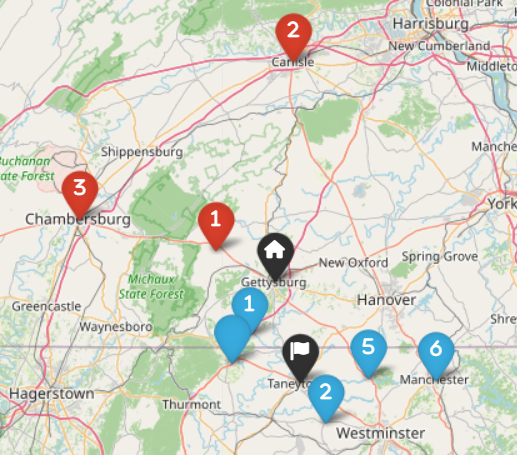
Here are some of the distances that the Union Corps had to march on June 29th.
- 1st and 11th Corps (blank icon) marched from Frederick to Emmitsburg – 23 miles
- 2nd Corps marched from Monocacy to Uniontown – 26 miles
- 3rd Corps marched from Woodsborough to Taneytown – 12 miles
- 5th Corps marched from Frederick to Libertytown – 11 miles
- 6th Corps marched from Hyattstown to New Windsor – 26 miles
- 12th Corps marched from Taneytown to Frederick – 23 miles
- Bufford’s Cavalry rode from Middletown to Fairfied – 8 miles
- Gregg’s Cavalry rode from New Market to New Windsor – 21 miles
- Kilpatrick’s Cavalry rode from Frederick to Littlestown – 31 miles
Newly appointed general of the Union Federal Army was Major General George Gordon Meade. He wanted the Union army to deploy between Middlestown to Taneytown to Manchester. He wanted to have strong fallback positions in northern Maryland. He wanted to protect Washington D.C. and Baltimore, and wanted to defend Mary-land, not Pennsylvania.