
Skip to content

Gettysburg Chronicles

History Explained

  • Home
  • Tales of War
    • History of Adams County
    • Call to Arms
    • Gettysburg
    • July 5th: Tillie Pierce Tale
  • Confederate
    • South Carolina
    • Mississippi Monuments
    • Florida’s Involvement
    • Spirit of Alabama
    • Georgia – The Peach State
    • Louisiana Secedes
    • Lonestar State
  • Union
    • First Shot Marker
    • Michigan Joins
      • 24th Michigan Joins Iron Brigade
      • 24th Michigan Prior to Fredericksburg
      • Farnsworth’s Last Ride
      • “Come On You Wolverines”
  • Artillery
    • Different Ammunition
    • Real vs. Fake Cannons
    • Six Pound Shot Cannon
    • Cannons at Devil’s Den
  • Families
    • Wade Family
      • Rise of the Captain
      • Trouble with the Law
      • Jennie Wade
      • Newspaper Articles
      • Gravesites of Jennie Wade
      • Samuel and Harry Wade
      • James John “Jack” Wade
    • Thaddeus Filby
    • Thorns
      • Evergreen Cemetery: August 1862 to June 1863
      • Gettysburg: June 26, 1863
      • Evergreen Gatehouse
      • Thorn’s Family Tree
      • Descendants of the Thorns
      • Aftermath of Battle
      • Thorn Important Locations
    • Georgia McClellan
      • Extended McClellan’s
      • Iowa Family – Lewis
      • World War II POW
      • Jennie Wade McClellan
      • Nellie McClellan
      • John McClellan
    • Pierce Lineage
      • Sons of the Pierce’s
      • Tillie – Prior to July 1863
    • Shriver Family
      • Shriver and Weikert’s Connection
      • Cole’s Union Calvary Disaster
      • Father’s Death
      • Henrietta’s New Life
  • Jim Britton McClellan
  • Buildings
    • Local Churches
      • St. Francis Xavier Church
    • Sach’s Bridge
    • Weikert Family Farms
    • Farnsworth House
    • Winebrenner History
    • Welty House
    • Cashtown
      • July 1863 in Cashtown
  • Other Locations
    • Andersonville
  • Railroads
    • G&H Railroad
    • Western Maryland Railroad
    • Location of the Spur
    • Gettysburg Electric Trolley
    • Trolley South of Town
    • Railroad to Round-Tops
  • Anniversaries
    • Battlefield Walks
    • 150th Anniversary – 2013
    • 152nd Anniversary – 2015
    • 157th Anniversary – 2020
    • 158th Anniversary – 2021
    • 162nd Anniversary – 2025
  • Paranormal
    • Paranormal Equipment
    • Pictures on the Bridge
    • Live: Sachs Covered Bridge
    • Spirits at the Farnsworth
    • Spirits at the Cashtown Inn
    • Tillie Pierce House Inn
  • About
  • Toggle search form

Strength of the Union

The nation, at least part of it, was rejoicing after the election of Republican nominee Abraham Lincoln. With the Republicans united and the Democrats divided, there was a race to the finish line. Even though there was four people on the ballot for the 1860 election, no one in the South voted for him, but he still won the electoral college votes. Mr. Lincoln was elected for the 16th president of the United States on November 6th, 1860.

Even before he moved to Washington D.C., his testament to joining the country was already being tested. Northern states wanted a unified nation without slavey, however, Southern states wanted it. On December 20, 1860, the state of South Carolina seceded and withdrew from the Union. Between December 20th, 1860 and March 1st, six additional states seceded and formed the Confederates States of America.
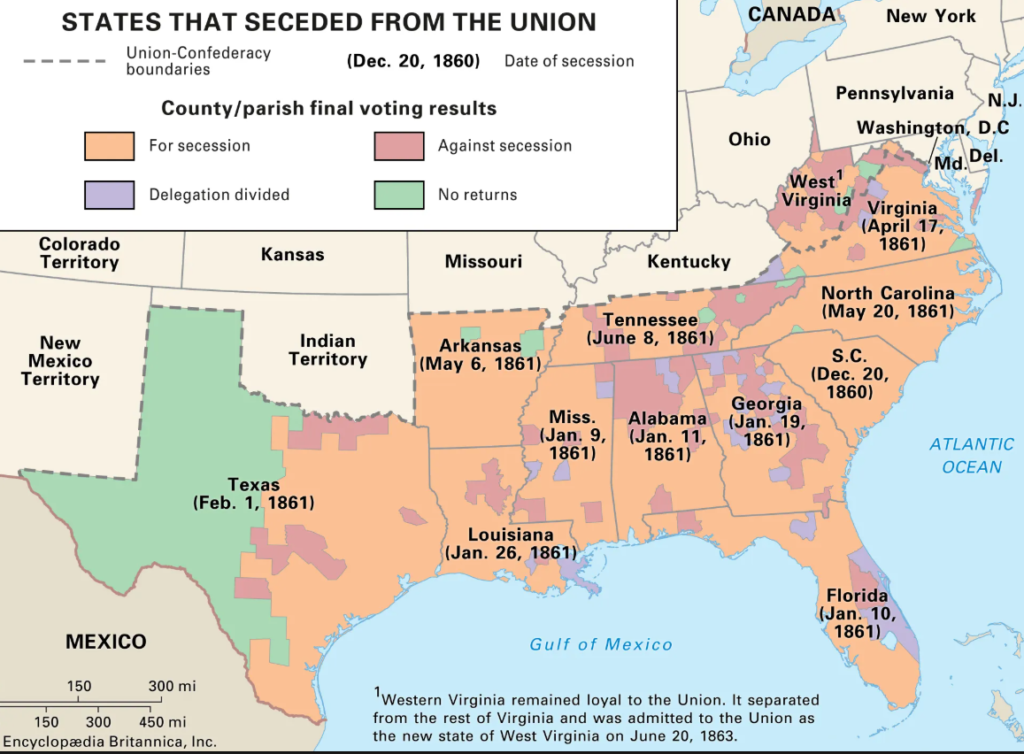
Above is a map that shows the timing of when the Southern states seceded from the United States and joined the Confederate States of America. The main reason that the Northern states fought in the Civil War was to defend the nation and secession was seen as a threat. Union soldiers thought that by not believing in the same beliefs to keep what the original declarations stated, they were then to defend the Constitution and its people. But the main reason that the North and the South fought against each other in the Civil War was to end the institution of slavery.

Union soldiers were contained to 23 different states in the North, mainly north of the Mason-Dixon line. Confederate soldiers were from the secession of 11 states, which was fighting for the preservation and the expansion of slavery. The main reason for the North versus the South was preserving the American Dream. However each dream was different from one another.

In total, these were the numbers of the entire Civil War between 1861 to 1865:

  • Approximately 2.4 to 2.7 million soldiers from Northern States fought
  • Approximately 360,000 Union soldiers died during the Civil War
  • Approximately 300 to 400,000 Confederate soldiers died during the Civil War
  • Approximately 150 to 200,000 African Americans fought during the Civil War
  • Apprxoximately 100,000 women worked as nurses, spies, or fighting with their husbands

Luckily, most of the Union soldiers had the same thought as President Lincoln and that was to preserve the Union and end slavery.

@ 2026 Gettysburg Chronicles

Powered by PressBook WordPress theme