
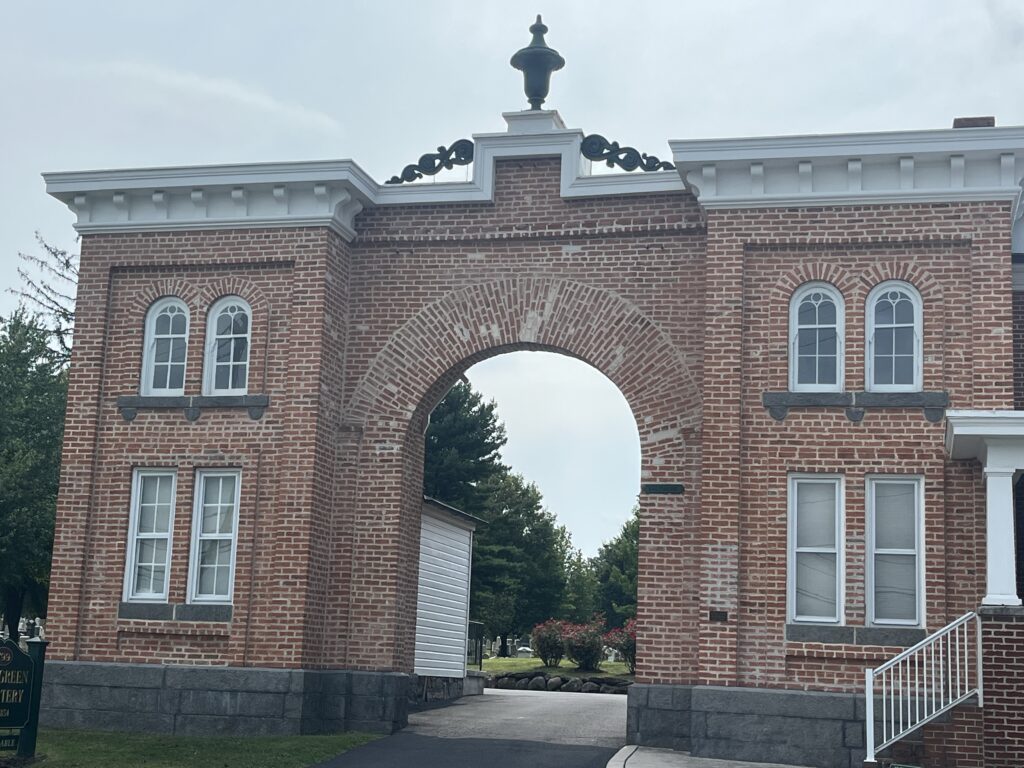
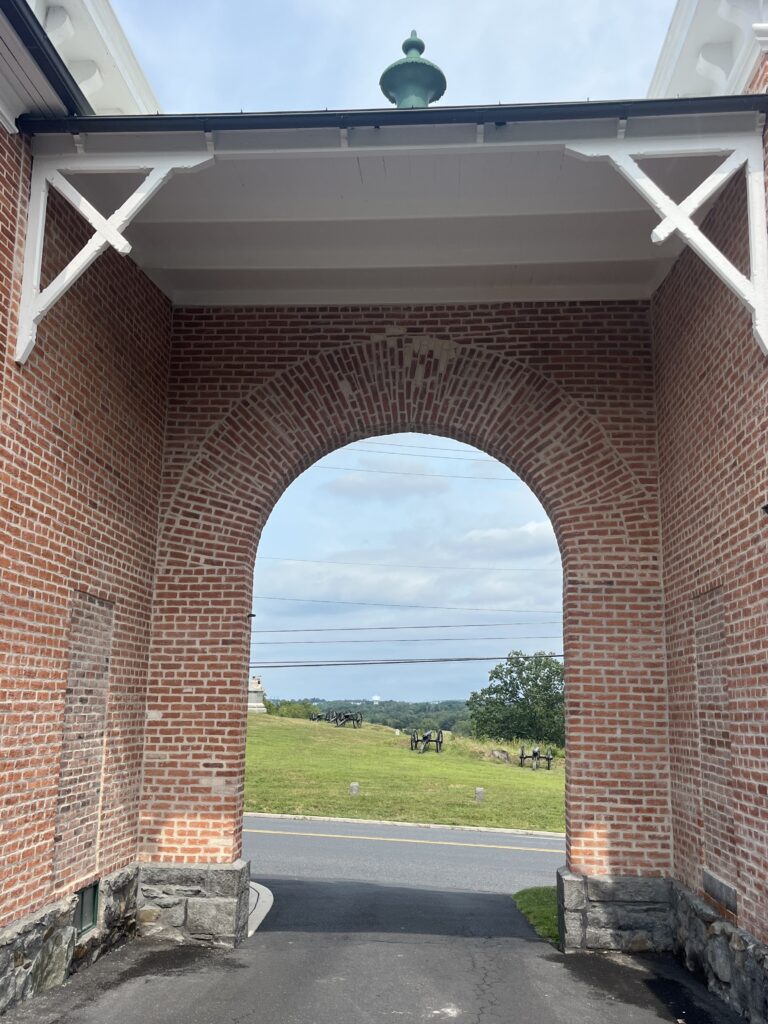
The most iconic structure in Gettysburg that was here during the time of the battle is the Evergreen Gatehouse. It was used for the home of Elizabeth and Peter as well as her parents. The archway has two sections that look like “towers” and a middle that connects the two. The southern tower was for Elizabeth, Peter, and their three young children prior to the Civil War. The northern tower was for Elizabeth’s parents that immigrated with her from Germany to the United States. The archway in between can not be accessed between both towers. Once Peter went off to war, Elizabeth had to assume the responsibilities that her husband had for being the caretaker of the cemetery.
In late June 1863, she saw Confederates race past the Cemetery in chase with Union militia and found out that they had killed local Gettysburg native, George Washington Sandoe. Elizabeth then had to put her emotions aside because they came to the Gatehouse in search of food and water. That was Elizabeth’s and her children’s first experience with any type of military action. They were probably scared, but at the same time, they knew that they had to be prepared with the approach from the newspapers that the Confederate Army was moving northward. Were they moving into Pennsylvania, or into northern Maryland? That was unsure at that time.
A few days later, on Wednesday July 1st, Elizabeth looked out and saw Union soldiers arriving in haste from all directions. She probably told her children to stay close to the Gatehouse and not wander off. Being the caretaker, she was tending to her work throughout the day, but returned to the window and look to see what was going on north of town. In the afternoon, she noticed Confederate forces moving the men of blue southward through town towards her at Cemetery Hill. As this was all happening, she also noticed Union Cavalry and their cannons being put into positions to East Cemetery Hill across the Baltimore Pike.
Just after that happened, there was a knock at the door at the Gatehouse. Elizabeth answered the door, and was greeted by a Union soldier, dressed in blue. As the conversation persisted, she learned he was a member of General Otis O. Howard’s staff. The staff member asked for the man of the house, but Elizabeth said that her father spoke no english and that she was the caretaker of the Cemetery and Gatehouse since her husband was off with the 138th Pennsylvania fighting in the war. The staff member said that he was to find information about the Gettysburg borough, the terrain, and the roads that flow out of it to help the Union Army win this fight against the incoming Confederate Army. As Elizabeth and the staff member left the Gatehouse, other Union soldiers were concerned about her safety as she pointed out the different landscape features and roadways leading in and out of Gettysburg. Afterwards, Elizabeth was escorted home in fear of the incoming fight.
Later in the evening on July 1st, there was another knock at the door of the Gatehouse. Elizabeth answered the door as three generals stood in front of her requesting a good meal. The generals that arrived at the Gatehouse were: General Daniel Sickles, General Oliver Howard, and General Henry Slocum. Now remember, the Confederates asked for a good meal a few days prior. Now, Elizabeth had to cook a meal for these Generals that would hopefully save her town from destruction. As the Union Generals talked among themselves during the meal, Elizabeth noticed her three young sons watching and listening. As the Union commanders left after the meal, General Oliver Otis Howard warned Elizabeth and her family that there would be brutal battle the next few days. He urged them to go into the cellar, but then rethought it and told them to the leave, and they headed south away from this place. In total, there was 17 civilians that were in the Gatehouse that evening. There was another family there, but unsure of whom it was. Elizabeth, her three boys, her parents were ones that are make up the Thorn family. Who were the other 11 people?
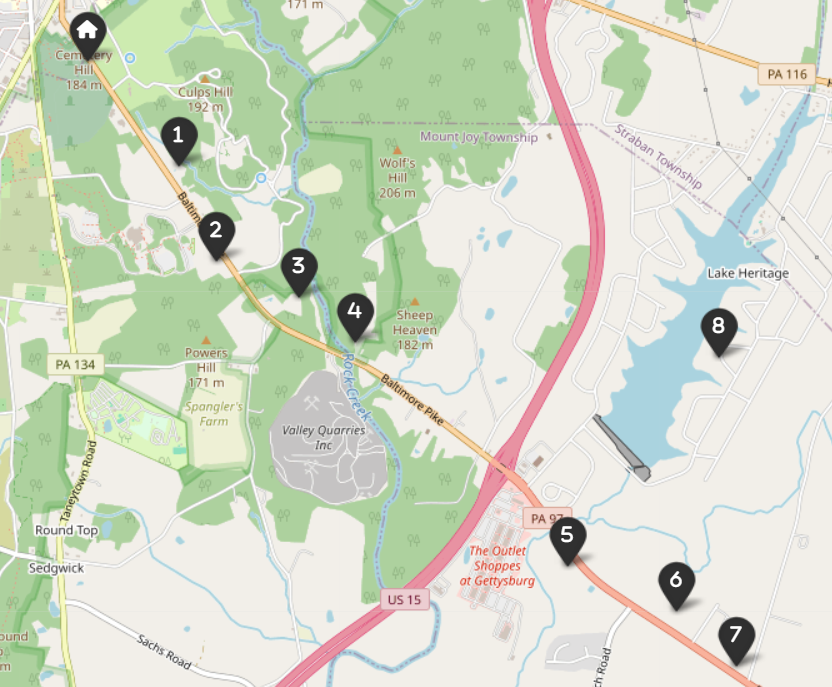
In the morning on July 2nd, between seven and eight o’clock, an order was sent to the Gatehouse to abandon their house and cellar and head south along Baltimore Pike as an artillery exchange took place. As shelles kept bursting behind them, the Thorn family walks down the street to an unknown area. Elizabeth mentions in her memoirs that they went to several different Union civil war hospitals along Baltimore Pike. There are a few that are left standing in 2025 that they could have stopped at, but not all of them are mentioned. There are letters from Elizabeth Thorn that they stopped at Henry Spangler Farm, the Peter Baker Farmstead, and the Henry Beitler Farm. Here are the farms that they could have stayed around, found food and water, or found shelter at from July 2nd morning to July 7th on this map:
- 1 – Henry Spangler Farm – 12th Corps commanded by General Slocum – Field Hospital
- 2 – Nathanial Lightner Farm – 12th Corps Hospital
- 3 – McAllister Farm and Mill –
- 4 – Peter Baker Farmstead –
- 5 – Daniel Sheaffer Farm – 3rd Corps commanded by General Sickles – Field Hospital
- 6 – Isaac Lightner Farm – 1st Corps commanded by General Newton – Field Hospital
- 7 – Henry Beitler Farm –
- 8 – 1003 Barlow Road – Farm
The structures that remain are now all private residences, minus location three that no longer exists.