
Robert McCurdy (1736-1810) would marry Ann Creighton in 1761 and lived in Pennsylvania. The McCurdy family was full of veterans that fought battles in Scotland and the pride to fight kept going once the family moved to the Americas. Robert and Ann married in May 1761. He joined the the militia and fought within the American Revolutionary War in 1776. He would survive and they had approximately five sons and six daughters. One of his sons was James.
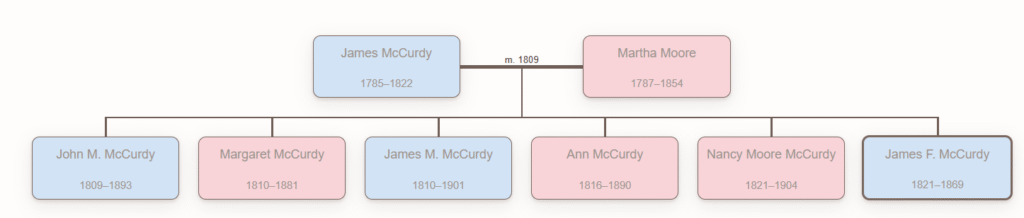
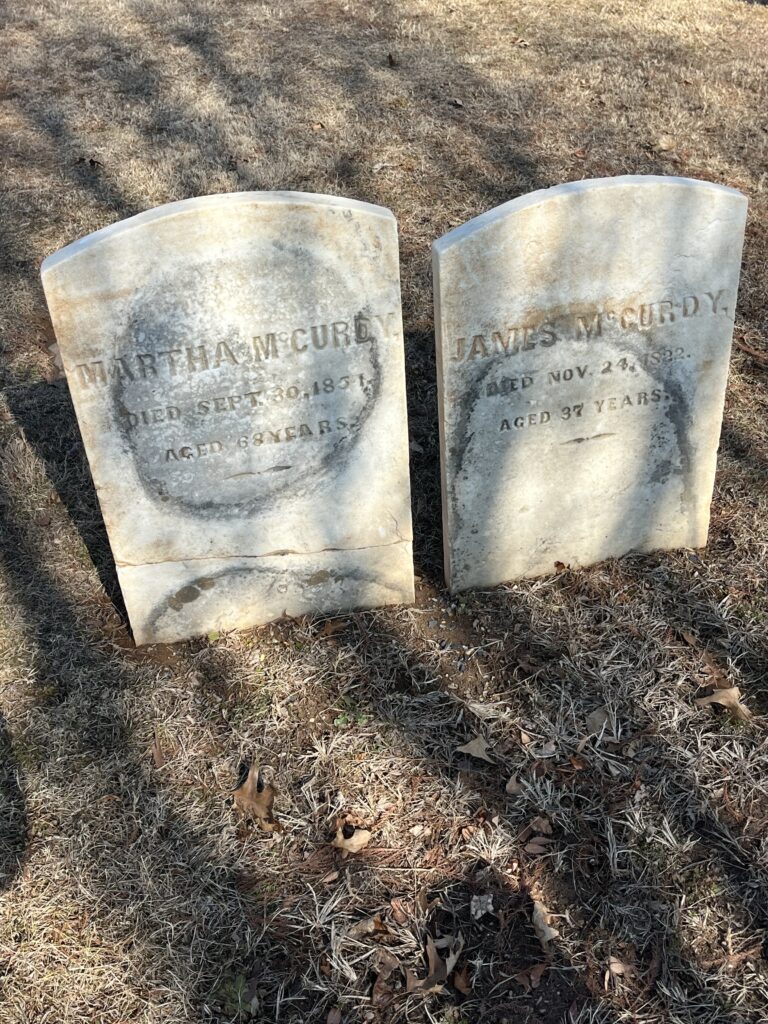
James McCurdy (1785-1822) was a farmer outside the Gettysburg limits. He married Martha Moore (1787-1854) in 1809 and would have three sons and three daughters. Both of them are buried within Evergreen Cemetery.
This family tree above shows their six children. The first child, John M. lived mostly in Kansas and Missouri and some of the information about him is unknown. The second son, James M. may have been unmarried and traveled through the western frontier. Their third son, James F. married Caroline Montcalm, but they had no children. Their third daughter, Nancy Moore McCurdy married John Adam Swope and is buried in Evergreen Cemetery. Mr. Swope is not related to the Swope Manor that is located at the intersection of York and Stratton Street. The second daughter, Ann McCurdy, married Robert Martin and they had no children, and both are buried in Evergreen Cemetery. History only truly remembers their first daughter. Their first daughter is Margaret McCurdy.
Margaret McCurdy met James Pierce in Gettysburg, and they married in 1835 or 1836. They lived on Baltimore Street and would have six children, with one of them dying under two months old. Only four would reach adulthood. Looking at the four children, here is the family tree.
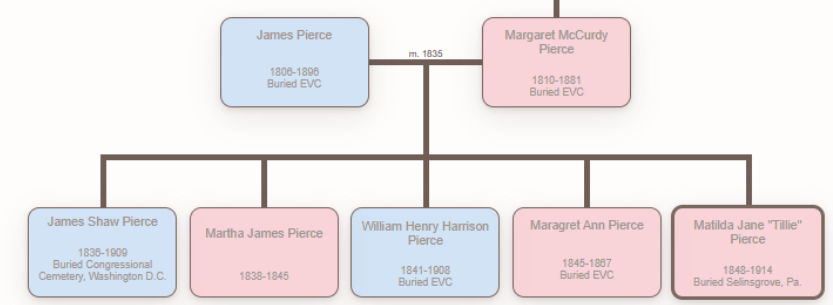
Luckily, all of James and Margaret’s children were born prior to the Civil War. They would live in Gettysburg and were one of the wealthier families in town. Their father, James, was a butcher and the family lived above the shop. Multiple famous families lived on the same street, and they were only a stone’s throw away from the center of town and the ridges south of town. The children grew up in a developing town that was growing each year. Wagons and horses from Maryland and elsewhere would pass through Gettysburg since it became a borough prior to their parent’s birth in 1786. However, all of these children above would hear and see the Civil War approaching and witness it in their own terms.