
The Union Federal Army had a general change on June 28th. President Abraham Lincoln accepted the resignation of Major General Joseph Hooker. A few days prior, Lincoln met with General John F. Reynolds. Lincoln wanted to appoint Reynolds as the commander of the Union Army, however, Reynolds didn’t want to worry about the political aspects of the war, so he declined. On the 28th, Lincoln appointed General George G. Meade as the commander of the Army of the Potomac. Later that day, George Meade ordered all Corps commanders to concentrate around Frederick (1) on the map.
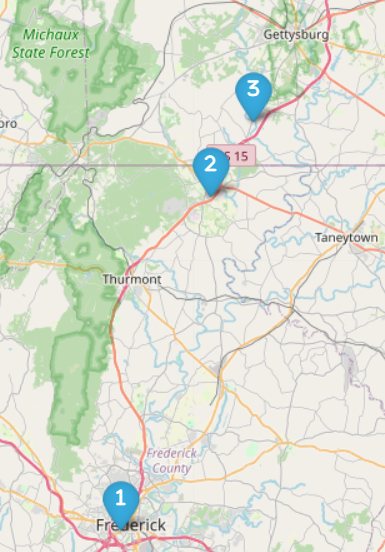
Several Corps commanders were already in and around Frederick on June 28th. The 1st Corps was here and was on the move to the second point (2) on the map on June 29th. They headed north approximately 22 miles towards Emmitsburg, Maryland. The 1st and the 11th Corps moved here on June 29th, with other commanders in toe about a day behind. On June 30th, the 1st and the 11th Corps moved towards Marsh Creek (3), about six miles south of Gettysburg. The 1st Corps had three major generals: John Reynolds, Abner Doubelday, and John Newton.
Major General John F. Reynolds had the 1st Brigade of the 1st Division move in front of the entire Corps. The 1st Brigade was that of the Iron Brigade. The Iron Brigade consisted of the 24th Michigan, 2nd Wisconsin, 6th Wisconsin, 7th Wisconsin, and the 19th Indiana.
The 24th Michigan was commanded by the following soldiers:
- Colonel Henry Morrow
- Lt. Col. Mark Flanagin
- Major Edwin Wright
- Captain Albert Edwards
They were the left flank of the Iron Brigade as they raced across McPherson’s Ridge towards Willoughby Run. Ahead of them, they rushed forward and attacked the Confederate brigade under General Heth which included the 1st, 7th, and 14th Tennessee and the 13th Alabama.