
Near the intersection of Pumping Station road (Millerstown road) and West Confederate Avenue are two state monuments dedicated to the South. One is that of the monument to Mississippi. The other is more unusual and that is to the state of Louisiana. Both states had their troops travel a far distance to the northern battles in the Eastern Theater considering that there was war raging in the South. The state of Louisiana seceded on January 26, 1861. It was the last of the five states to secede in January 1861. None of the veterans saw their monument installed at Gettysburg.
At the time of the secession, the largest city in the Confederacy was New Orleans. The census in 1850 showed that the city was the sixth overall largest in the United States, with it being the only city in the South over one hundred thousand citizens. A decade prior to the census, New Orleans had the largest slave market in the South, which contributed to the wealth and the population.
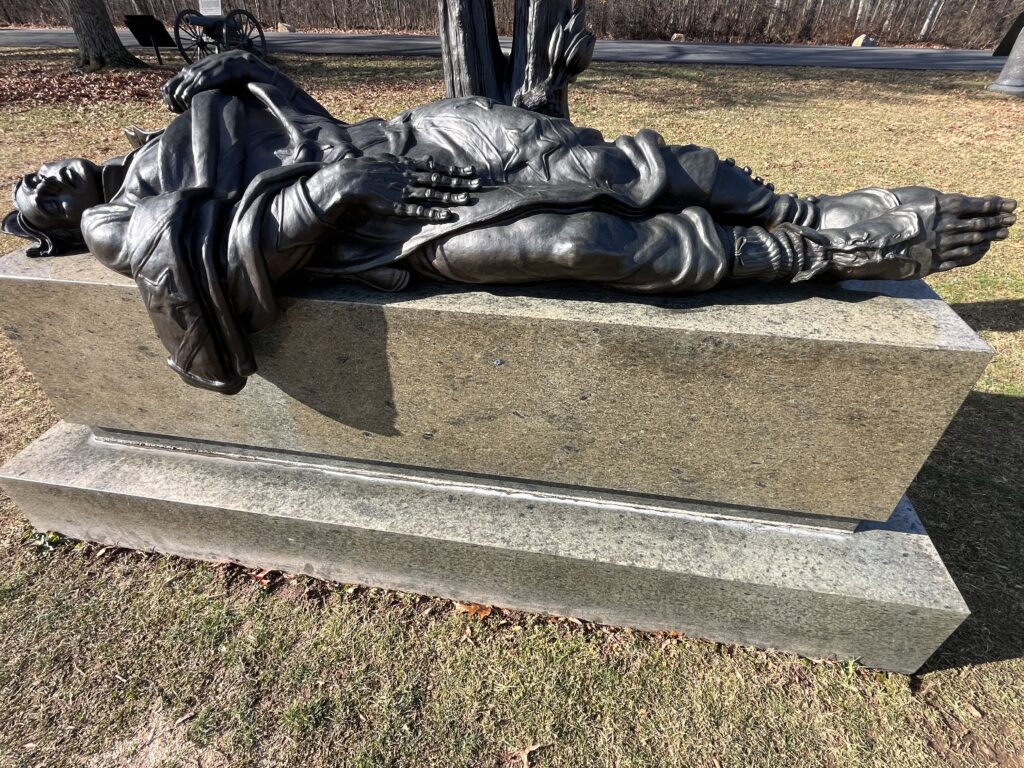
Two main brigades were here from Louisiana with five regiments in each. The first was from Nicholl’s brigade which consisted of the 1st, 2nd, 10th, 14th, and 15th and mainly fought on the Culps Hill side of the battlefield. The other brigade was the more famous brigade called the Louisiana Tigers who was commanded by Brigadier General Harry T. Hays. The “Tigers” was consisted of the 5th, 6th, 7th, 8th, and 9th regiments. They mainly fought on East Cemetery Hill on the evening of July 2nd. Approximately 3000 soldiers were here at Gettysburg and about 700 or so became causalities.
This monument was dedicated in June 1971 and looked very different than it looks today. The monument itself represents the 14 regiments that fought here. The statue was created and polished green bronze in Italy and was transported here for the dedication. It is ten feet tall and represents the Spirt of the Confederacy. There are two statues on the monument. Each has its own meaning and enhances realism. The first statue is of a mortally wounded gunner representing the New Orleans Washington Artillery that is lying on the ground clutching the regimental flag to his heart. The artist that created this monument was Donald Delue’s. His trademark is the exaggerated size of the hands and feet on his figures.
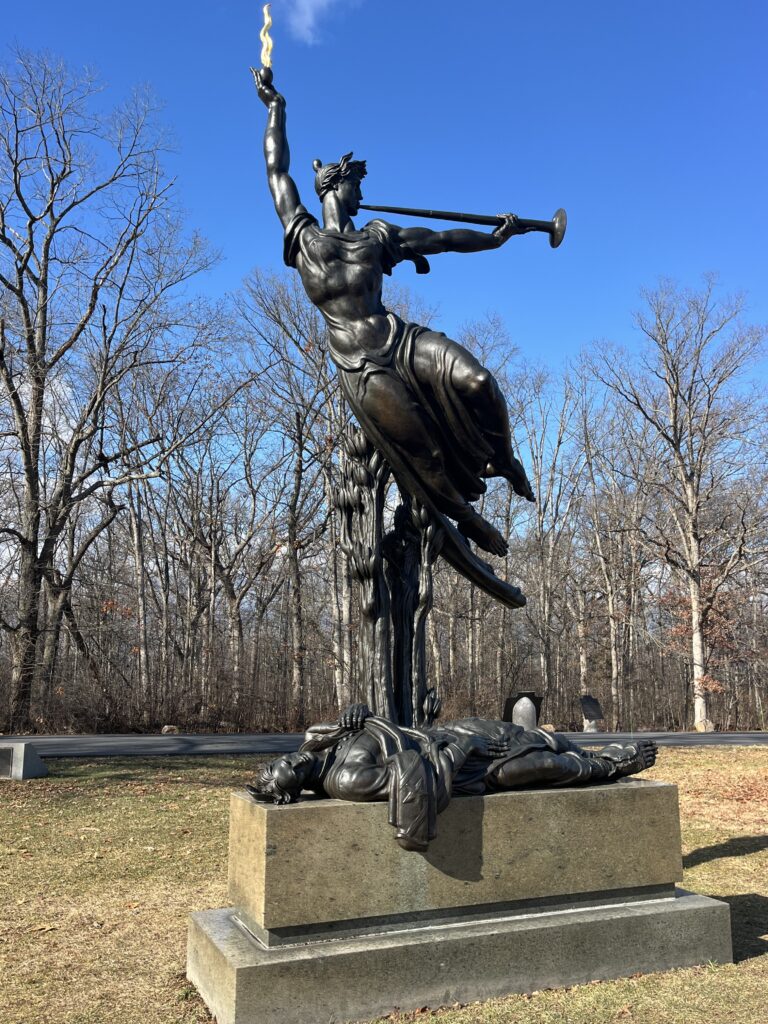
The second statue on the monument represents Saint Barbara, who was the patron-saint of artillerymen. She is holding a flaming cannonball in his hand. The history tale shows that she lived in Asia Minor around 300 A.D. and was condemned to death by beheading for converting to Christianity. With the invention of gunpowder and metals for cannonballs, also shows the creativity of how the statue portrays both with the flame. Saint Barbara is resting on two trunks that have a dove in between trying to show that peace is ahead for the mortally wounded soldier lying at her feet.