
His parents prior to being born were British Shakespearean actors and actresses. They were married in 1821. John’s father, Junius Brutus Booth would pass away prior to the Civil War beginning. His mother, however, would have to live through the Civil War and pass away in 1885. John Wilkes Booth was the 9th child born to the couple in a cabin in Bel Air, Maryland.
Growing up, John Wilkes Booth was athletic, popular, and skilled in fencing and horsemanship. He was in school, and he had his fortune read when he was around 15-16 years old. The fortune teller read his palm and it pronounced a grim destiny:
- He would live a grand life, but it would be short
- He was doomed to die young, and his death would “end badly”
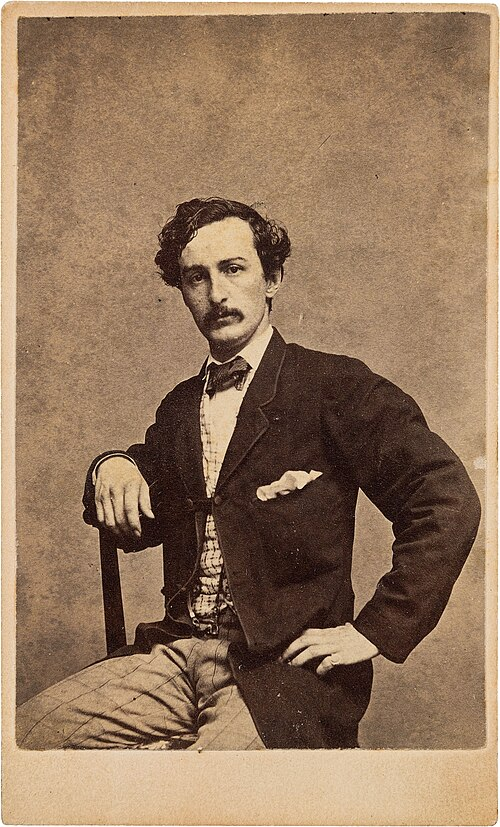
On August 14th, 1855, John Wilkes Booth made his stage debut at the Richmond Theater. He was a supporting role of the Earl of Richmond in Richard III. Three years later, on October 5, 1858, he was now twenty years old and was playing Horatio in the play Hamlet. Just in 1858, John W. Booth was an actor in 83 different plays! In reference to his success growing up, he was very wealthy. In 1860, he was averaging around $20,000 per year, which in 2025 would be approximately $700,000 dollars as a salary.
The Civil War started in April 1861 at Fort Sumter, South Carolina. During the first two years of the war until January 1863, John W. Book was mainly in plays across Union regions in cities like Chicago, St. Louis, New York City, Boston, Baltimore, and Cleveland. Something happened in 1863 though, when Ford’s Theater opened on November 9th.
President Abraham Lincoln was in the presidential box in November 1863. John Wilkes Booth waved a finger at him as he was in a leading role. On November 25, 1864, in New York City, something amazing happened. John Wilkes Booth and his brothers for the first and only time, was in a play all together. John Wilkes Booth played Mark Anthony, Edwin Booth played Brutus, and Junius Booth played Julius Caesar. A few months later, John Wilkes Booth final acting performance was March 18, 1865. Surprisingly, less than a month later, the Civil War ended on April 9, 1865.
Between 1864 and 1865, John Wilkes Booth was growing more obsessed with the Southern worsening conditions and was angered when President Abraham Lincoln ran for re-election. Booth was strongly opposed to the ending of slavery. Booth was Pro-Confederate. He hated Abraham Lincoln and Booth was alleged to be a member of the Knights of the Golden Circle. Even though he was engaged to a northern gal named Lucy Lambert Hale, she was unaware of his hatred towards Lincoln.