
After the Civil War ended on the afternoon of July 3rd, the streets of Gettysburg became empty with debris from the wagons, and the Confederate and Union soldiers. Confederate soldiers had retreated towards the Seminary Ridge and Cashtown while Union soldiers slowly pressed northward through town. Soldiers who were wounded needed to find places to stay to get looked at by the nurses and surgeons.
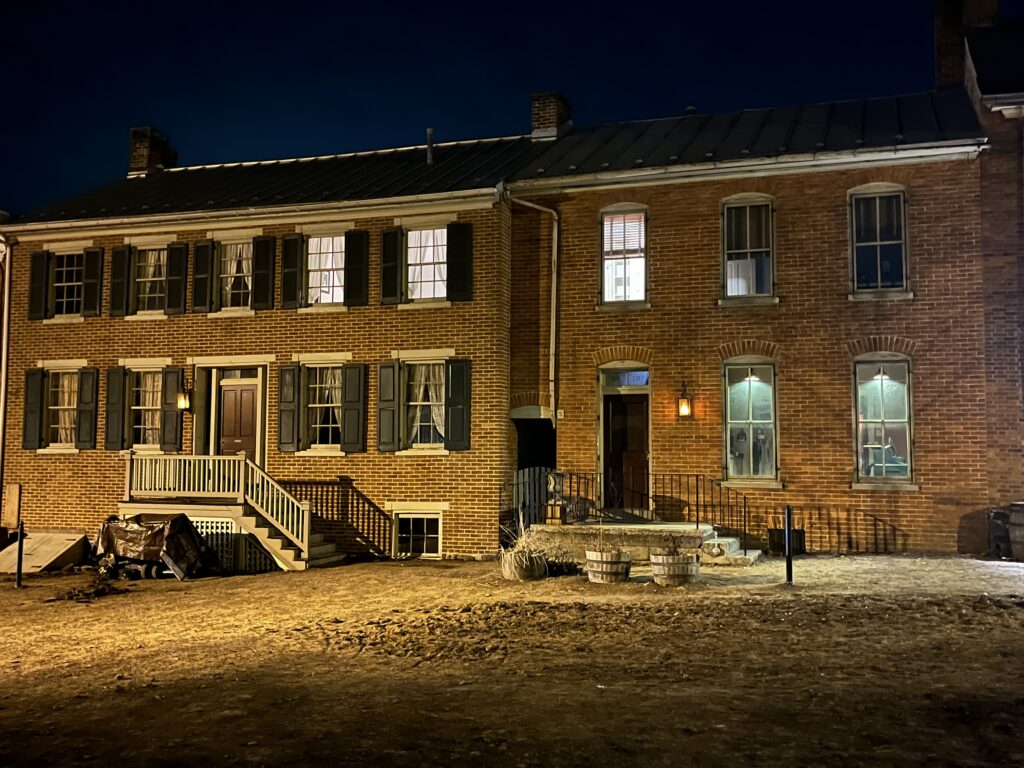
The Tillie Pierce and Shriver House were not ruled out for these situations as well. Tillie Pierce’s house became a hospital for a colonel of an important regiment that lost many of his fellow soldiers on July 2nd. Let’s slowly dive into his story before coming back to the Inn to see if he survived the battle of Gettysburg.
William was originally from New York State, with his father having the same name and his mother’s maiden name was Mary Love. William was the fourth child, but the first son of the family. William studied law at Fredonia Academy and Millard Fillmore. He moved westward onto the Northwestern Territories and settled in Minnesota. He settled in Red Wing and began practicing law.
Okay, a quick break on this for a moment to come back to reality. I’m a Detroit Red Wings fan, and my wife’s maiden name ends in Love. That’s an interesting fact!
Minnesota joined the Union in 1858. William along with other men of the state almost immediately offered their services for Lincoln after the attack on Fort Sumter in April 1861. The 1st Minnesota claimed to be the first regiment raised for the Federal Army. William participated in many battles at the beginning of the Civil War. He engaged at the Battle of the First Manassas in July 1861, the Peninsular Campaign in Spring 1862, the battle of Antietam in September 1862, and the the battle at Fredericksburg in December 1862. Shortly before the battle of Gettysburg, he was promoted to to Colonel and commander of the regiment.
A few days prior to Gettysburg, his horse was shot out from under him, and his horse passed away during the Battle of Haymarket. On June 29th, William was arrested. The reason was the following: He allowed his men to cross a three foot deep river on logs. The order was to wade across.
At the Battle of Gettysburg, William lead his men towards Cemetery Ridge. His regiment was part of the 2nd Corps commanded by Major General Winfield S. Hancock, 2nd Division commander Brigadier General John Gibbon, 1st Brigade commander Brigadier General William Harrow. During the afternoon of July 2nd, Confederate soldiers were rushing the Union line. Hancock ordered Colonel William and his men of the 1st Minnesota forward. During the charge, the 1st Minnesota lost 215 of the 262 became causalities. Of the 215 soldiers, 47 were killed, 121 wounded, and 47 went missing. However, the charge saved the Union line before reinforcements arrived. The regiment lost five flag bearers.

Courtesy of the Minnesota Historical Society
He is Colonel William Colvill, the commanding officer of the 1st Minnesota. During this fateful charge, he was hit with musket shot a few different times. One was a minié ball that struck the top of his right arm, before lodging into his shoulder blade. The second shot shattered his right ankle. He rolled himself to a dry creek bed before falling unconscious. He was found later in the evening and was carried to a field hospital at a nearby barn. Luckily he was found because later that night, a torrential rainstorm arrived and flooded the creek. Several days later after being in a field hospital, he was brought to the Tillie Pierce House. His sister cared for him, along with Mrs. Pierce, and Tillie after she returned from the Jacob Weikert farm.
Col. William Colvill returned to Gettysburg in 1866 to visit the battlefield and spent a few moments with the Pierce family. He married in 1867 and barely spoke about the battle of Gettysburg to his dying day. The loss of so many of his men during the charge of the 1st Minnesota was too painful.
Today, the Tillie Pierce House is an Inn that you can stay at and enjoy the history of her family, the house, and the town of Gettysburg.