
Just north of the town square is a small avenue where there was intense fighting that the Union was trying to hold off the advancing Confederates. There is also controversy about the soldiers that were ordered to stand the line, and there is sadness along with this group too. This location is hard to find, unless you know exactly where this small avenue is.
Most avenues are blocks long, while this one in Gettysburg is less than two blocks. It’s one block of pavement, and the other is one block of grass. The Union soldiers from the 11th Corps marched northward from Emmitsburg. The battle ragged in the morning with the 1st Corps northwest of their location along the heights. The 11th still under the command of Oliver O. Howard, had three divisional commanders under General Francis C. Barlow, General Steinwehr, and General Schurz. These three commanders had 26 regiments of men along with five batteries of cannons. These soldiers had something to prove. The previous battle they were chased off the battlefield by the approaching Confederates and were then called the “Flying Dutchmen”.
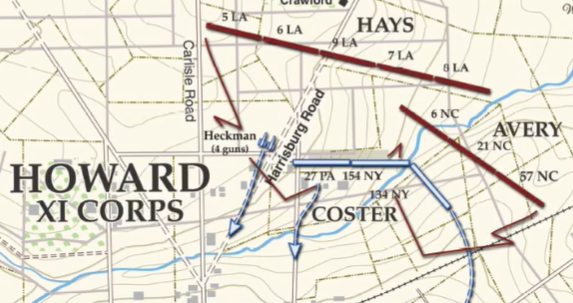
The brigade to focus on is under the 2nd Division of Major General Adolph Von Steinwehr who had the strength of 2800 soldiers, and the 1st Brigade under Colonel Charles R. Coster with the strength of 1200 men. The 1st brigade consisted of four regiments which are listed below with their commanding officer:
- 134th New York Infantry commanded by Lt. Col. Allen H. Jackson
- 154th New York Infantry commanded by Lt. Col. Daniel B. Allen
- 27th Pennsylvania Infantry commanded by Lt. Col. Lorenz Cantador
- 73rd Pennsylvania Infantry commanded by Capt. Daniel F. Kelley
These soldiers in these four regiments were positioned on the far right of the northern field of battle in hopes to give the other soldiers on Barlow Knoll some support as they retreated from the advancing Confederates. However, on the map above, the 73rd isn’t to be found. They were positioned at the square in reserve for the other three regiments. In total, approximately 900 soldiers were awaiting the Louisiana Tigers under Confederate General Hays and North Carolina soldiers under General Avery. The afternoon of July 1st between 3:30-5pm was the time that the Flying Dutchmen stood their ground.


The current location is surrounded by houses. However, back in July 1863, it was open farmland of corn and wheat. Confederate soldiers were advancing from the north and the east, and Union forces were only made away of the northern enemies from scouting reports. They were flanked from North Carolina soldiers on the extreme right. Union soldiers had between 5 to 15 minutes of fighting before retreating themselves. The monument in front of the mural is that of the 154th New York infantry. With that monument, our next story with originate from.