
As of my research through 2025, there was just a general map that showed a possible spur between the Gettysburg and Harrisburg Railroad and the Western Maryland near Washington Street. Every historian knew it curved and approximated where the turn was. A recently found old drawn out and very detailed Western Maryland Train map shows exactly where the curve is and much more. Hopefully this map along with others will help historians of the Civil War Battle, the town of Gettysburg, and Western Maryland enthusiasts enjoy the history that is saved.
After some adjusting to make it more easier to view and to interpret, some colors have been added. Let’s dive into the map below.
The Red line from north to south on the map is Washington Street. The Blue line is the path of Steven’s Run through the western portions of town. The Yellow box is the current and former location of the Gettysburg and Harrisburg Train Station that was built in the 1880s along Washington Street. I didn’t highlight it, but it also shows the platform for the station for both sets of tracks north and south of the station. The Orange box is the location of the former Gettysburg Ice and Storage Company. Multiple buildings within the “Ice House Complex” are still along the railroad tracks and are used by Gettysburg college students.
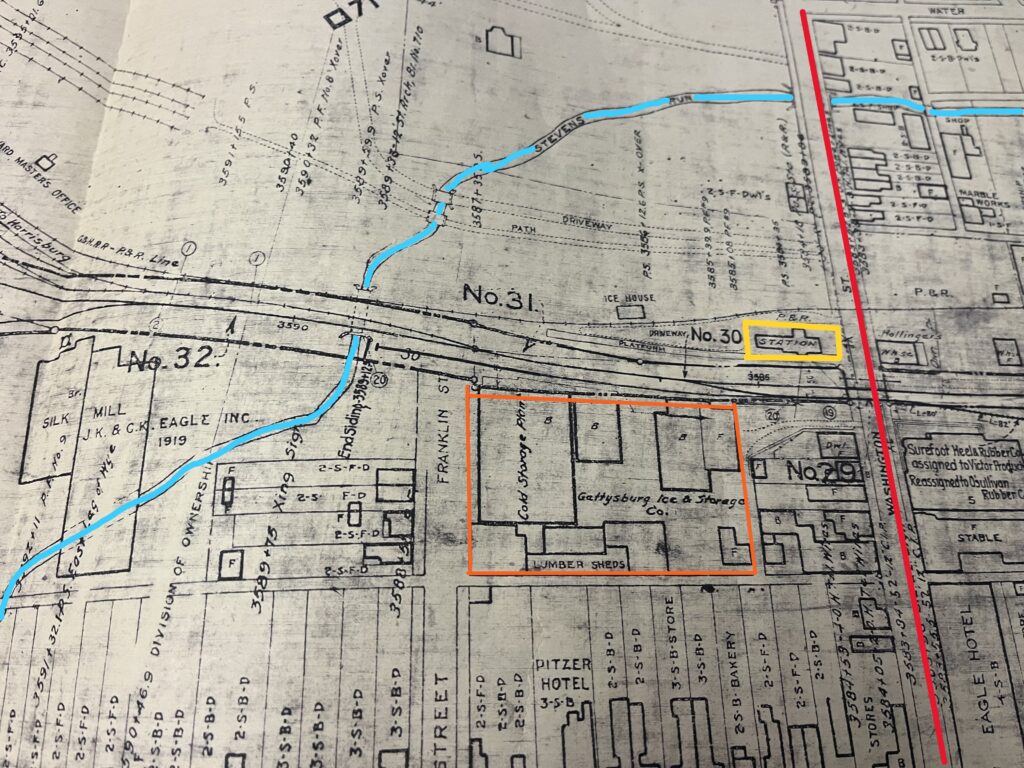
First off, notice the amount of detail on this Western Maryland Railroad map of the western portions of downtown Gettysburg back in the early 1900s. Whomever did this map looked into different parcels and property lines across town, added in roads, avenues, and alleys, Steven’s Run, and added in multiple lines of the railroad. The building in the far bottom right shows the location of the former Eagles Hotel, which is now the current location of the Seven-Eleven.
Since my knowledge of Gettysburg since 2000, there is one set of railroad tracks that crosses at Washington Street. A siding is in front of the North Washington Street station, but doesn’t cross the road. In this map below from 1919, it shows at least four different lines, possibly five, that cross the street. Just imagine the amount of locomotives, freight, livestock, and coal cars and the stench of the smells coming from all the moving machines moving near this area during this time period.