
This Catholic Church is located at 25 West High Street in downtown Gettysburg. This church is one of the oldest in town and the history behind it is quite accessible on their website. The parish itself is close to the beginnings of the Catholic Church in the English Colonies. Jesuit priests ministered regularly in Conewago Township in the 1720s. However, their history goes further back. “Disciples of all nations” evidence shows that the Jesuit priests journeyed to the Conewago Valley as early at the 1690s. One of the French Jesuits kept a journal and originates in the Great Lakes near Lake Huron. Within this journal it states that French priests were in this vicinity in the middle 1640s. This Roman Catholic Church is the oldest church constructed by stone in the United States and was built in 1741. Their basilica was built between 1785 and 1787.
This Roman Catholic Church in Conewago Valley is a mere 12 miles away from Gettysburg. In this time period, there was no Catholic church in Gettysburg. Parishioners would have to take six to eight hours within a wagon to receive their divine service. They would have to take their families by wagon to Conewago Valley, Littlestown, or Emmitsburg. However, this was the case for 90 years!!
In the early 1820s, parishioners gathered together to start forming the plan to build a small church in Gettysburg. Instead of celebrating mass in a private house, they gathered the necessary paperwork and land and start a church. This location would be near the present day 333 to 349 South Washington Street and include a church and cemetery. This diagram below was from the parish achieves:
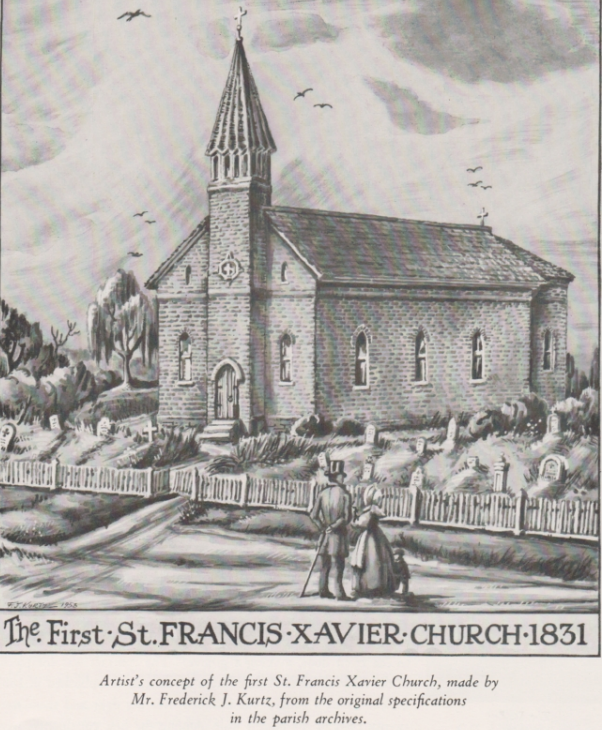
The cornerstone of the first Church was placed August 11, 1830, with no bishop present. Sermons were given in German and English at the ceremony. The steeple was struck by lightning in May 1831 and was dedicated in October 1831. Some of the first parishioners within the Catholic church were the names of Jacob Norbeck, Peter Martin, George and Nicholas Codori, and the Thompson families.
Immigrants made most of the Gettysburg community at this time in the 1830s and 1840s. St. Francis Xavier’s first pastor was the Rev. Michael Dougherty, S.J., born in Ireland in August 1791. He was ordained in 1826 and came to Conewago in 1829. He served in Gettysburg and Littlestown until 1844. He would have one service a month when the Church opened and would mainly say the sermon in German until 1843.
There was plenty of pastors between 1843 and the construction of the second church which occurred in the 1850s. The church was too small and the new priest, Father James B. Cotting, S.J., began to construct the new stone structure. The new church would have the following dimensions: 48 feet wide, 90 feet long and 40 feet high. The new church dedication was on July 31, 1853.
The next important pastor for the Church was the one that served the community during the Battle of Gettysburg. His name was Rev. Arthur M. McGinnis, a very young priest in his late 20s, and he served the Gettysburg community until October 1863.
During the battle of Gettysburg, St. Francis Xavier became a Civil War hospital. The battle started on July 1st in the morning, and by afternoon, Union troops were being driven south of town by the approaching Confederate forces. The workers within the hospital remained at their posts, treating Union and Confederate soldiers. Multiple soldier accounts from the hospital show the state of the hospital. One account from Colonel Henry S. Huidekoper of the 150th Pennsylvania Infantry Reserves received a severe bullet wound which shattered his elbow. His arm was bandaged at the McPherson Farm and he walked to the church prior to the Confederates driving the Union south of town. Several surgeons were onsite at the Church and Col. Huidekoper laid his arm on a pew gate and was submitted to an amputation of his arm. He mentions that he saw Confederate General Ewell and his staff outside of the Church on July 2nd.
A young lady, named Salome “Sallie” Myers brought food to me and she concealed it under her shawl. I would later walk down the street to her house and remained there until July 9th. She was helping many soldiers, one of them being Alexander Stewart. He would later pass away due to his injuries. His brother would arrive days later and retrieve his brother. He would later marry Sallie Myers and have a son, named Dr. Henry Stewart, a physician and a historian in Gettysburg.
Among the volunteers that served at the hospital, are those of the Sisters of Charity who arrived from St. Joseph College at Emmitsburg, Maryland. The Sisters of Charity could hear the battle from Emmitsburg and mentioned that the sounds of battle died on July 4th, and they traveled northward to see if they could provide their services. Sixteen sisters and their chaplain traveled by carriage reached the McClellan House, and was directed to St. Francis Xavier due to the worst amputation cases in the sanctuary. This is what they found when they arrive at St. Francis Xavier Church:
“The Catholic Church was filled with wounded, mutilated men. The Station pictures hung around the walls, and a very large oil painting of St. Francis Xavier, holding in his hand a crucifix to show the benighted pagans the sign of their Redemption. There was a Book read by our poor men, for we had in that Church but one Catholic, and our glorious saint was for the time resuming his apostolical mission among them. The first man put in the sanctuary was soon baptized, and with truly Christian sentiments. His pain was excruciating and when sympathy was offered to him he said, ‘Oh! What are these pains I suffer in comparison with those my Redeemer suffered for me.’ In these sentiments he died…. They lay on the pew seats, under the pews, in every aisle, and there was scarcely room to pass among them in the sanctuary and in the gallery. Their own blood, the water used for bathing their wounds, and all kinds of filth and stench added to their misery, for already gangrenous wounds had begun to infect the air, but no complaint from these poor men.”
While they cared for the bodies the Sisters did not neglect the souls of their patients. Many
were prepared for the reception of Baptism and many died with these holy women comforting
them with assurances of God’s infinite love and mercy. Catholics and Protestants alike were the
objects of their tender ministrations and the joy of seeing them die piously was the good Sisters’ great reward. Every effort was made to remove the wounded soldiers quickly to permanent hospitals in
Baltimore and to the central hospital, Camp Letterman, on the York road, but conditions were
such that the church was in use as a hospital for several weeks after the battle.
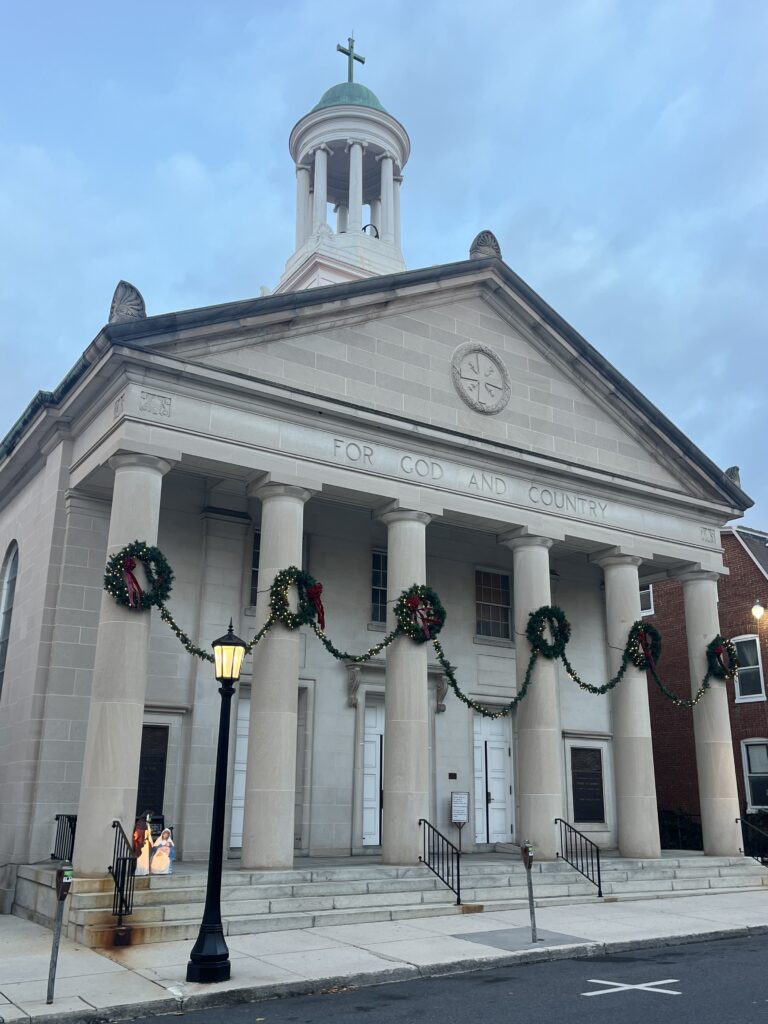
The memorial facade of the front of the church along with the pillars were installed in 1925. Fast forward to the end of 2025 for the Christmas Holiday season. This is the picture of the church that still remains in Gettysburg and serves church services every weekend.