
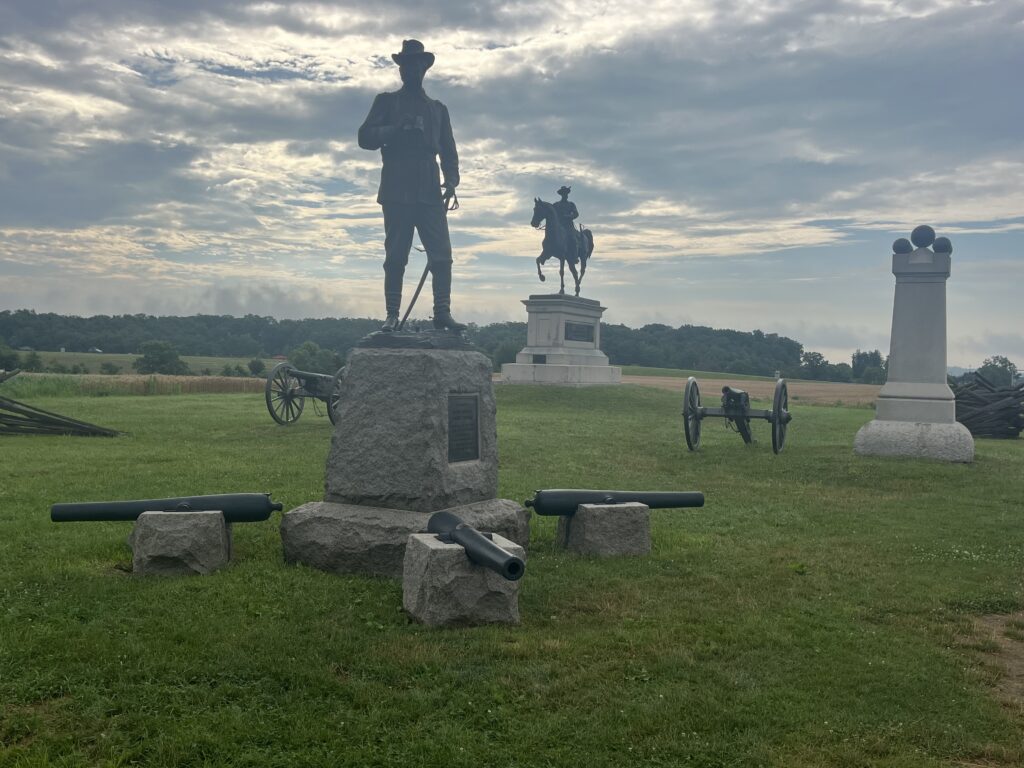
This Pennsylvania battlefield just north of the Mason Dixon line has plenty of monuments from the northern states. Of the Federal Union in 1863, eighteen states are represented at Gettysburg, minus Iowa, Kansas, Kentucky, and Missouri. Within the Union sculptures on the battlefield, select individuals, regiments, brigades, divisions, and corps are represented.
There are rules for how the monuments are placed during the 1870s to the 1930s. A regimental unit monument was required to be at the main line of their battleline. Secondary monuments would show different locations on where soldiers fought. Finally, the third thing that the Union regiments must contain would be flank markers. This markers are small in statue, about a foot or two tall, and mainly squared. They would show the approximate location of the forwardness of how far their regiment traveled.
These rules were formatted by the original committee that owned the battlefield around Gettysburg. As the civil war continued into 1864, an organization established the Gettysburg Battlefield Memorial Association (GBMA) who’s number one concern was to protect and preserve the area around town. Around 30 years later in 1895, the land holdings that the GBMA obtained were given to the Federal Government, thus making it a military park. This military park in 1933 was given to the Department of the Interior, or also known as the National Park Service in 1933.
Several different organizations own the land around the battlefield now, along with local museums, such as the American Battlefield Trust, the Gettysburg Foundation, and smaller establishments. For these different organizations, if the federal government shuts down, the battlefield remains open. The only thing for the most part that it limits is the amount of tours from the federal park rangers that they can offer.
Overall, there’s over 1300 monuments to Union and Confederate veterans and states, 150 historical buildings, and over 400 cannons that dot the landscape.