
Skip to content

Gettysburg Chronicles

History Explained

  • Home
    • Exploring Gettysburg:
    • History of the Author
  • Tales of War
    • Brief History of Adams County
    • Call to Arms
    • Gettysburg
  • Monuments
    • Confederate Monuments
      • South Carolina
      • Mississippi Monuments
      • Florida’s Involvement
      • Spirit of Alabama
      • Georgia – The Peach State
      • Louisiana Secedes
      • Lonestar State
    • First Shot Marker
    • Union Monuments
      • Michigan Joins the Union
        • 24th Michigan Joins Iron Brigade
        • 24th Michigan Prior to Fredericksburg
        • Farnsworth’s Last Ride
        • “Come On You Wolverines”
  • Artillery
    • Different Ammunition
    • Real vs. Fake Cannons
    • Six Pound Shot Cannon
    • Cannons at Devil’s Den
  • Families
    • Thorns
      • Evergreen Cemetery: August 1862 to June 1863
      • Gettysburg: June 26, 1863
      • Evergreen Gatehouse
    • Shriver Family
      • Shriver and Weikert’s Connection
      • Cole’s Union Calvary Disaster
      • Andersonville
        • August 25, 1864
        • After Andersonville
    • McCurdy-Pierce Lineage
      • Sons of the Pierce’s
      • Tillie – Prior to July 1863
    • Wade Family
      • McClellan Family
        • Extended McClellan’s
      • Jennie Wade
      • Newspaper Articles
      • Gravesites of Jennie Wade
  • Buildings
    • Local Churches
      • St. Francis Xavier Church
    • Sach’s Bridge
    • Weikert Family Farms
    • Farnsworth House
    • Winebrenner History
    • Welty House
    • Cashtown
      • Cashtown in the Civil War
  • Railroads
    • G&H Railroad
    • Western Maryland Railroad
    • Location of the Spur
  • Anniversaries
    • Battlefield Walks
    • 150th Anniversary – 2013
  • Paranormal
    • Paranormal Equipment
    • Paranormal on the Bridge
    • Spirits at the Farnsworth
    • Spirits at the Cashtown Inn
    • Tillie Pierce House Inn
  • Questions
  • Toggle search form

Gettysburg & Harrisburg Railroad

The Civil war ended in April 1865. Civilians and towns across the North and the South were beginning to reconstruct their lives after the battle. Veterans of the war had gone home to their families and their farms. Manufacturing and industries flourished and goods had to be transported from town to town. Wagons and boat/canals were one way to transport goods and items, but that wasn’t fast enough. In Gettysburg, this was the problem as well. The Western Maryland Railroad went from east to west across the county, but there was nothing to transport goods from back and forth to Harrisburg and Carlisle. This would all change in the beginning of the 1880s when the Gettysburg and Harrisburg Railroad (G&H R.R) was born.

The Gettysburg and Harrisburg Railroad was originally from Gettysburg northward to Hunter’s Run. After Hunter’s Run, there was another local small railroad called the South Mountain Railroad that would be towards Carlisle. The railroad was commenced in 1882, and began railroading goods and people northward in 1884. In December 1883, the grading for a new roundhouse in Gettysburg was being prepped. As the roundhouse was being prepped, another railroad called the Tapeworm Railroad was talked about. This railroad was supposed to go from Gettysburg to Fairfield to Waynesboro, but was never developed.
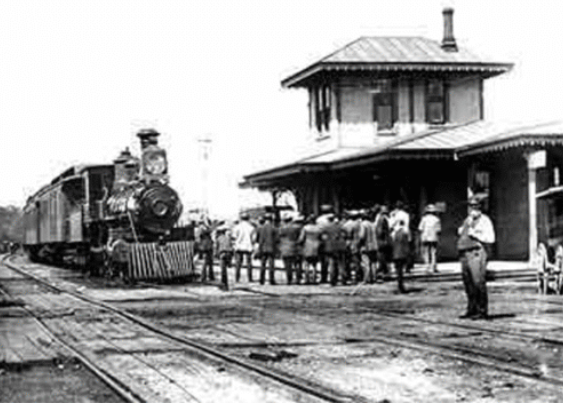
Courtesy of the Gettysburg Daily – March 14, 2009
This view was taken facing northwest circa 1885

The first train arrived at the South Washington Street Railroad station on February 26, 1884, and passenger service began in April 1884. A month later, another line of tracks was completed from east to west from the South Washington Station to the Western Maryland Depot located on Carlisle Street. The Western Maryland Depot was the same train station that President Abraham Lincoln arrived almost twenty years prior in November 1863 for the Gettysburg Address.

 On the 25th anniversary of the battle, over 130,000 passengers were brought to this station.

@ 2026 Gettysburg Chronicles

Powered by PressBook WordPress theme