
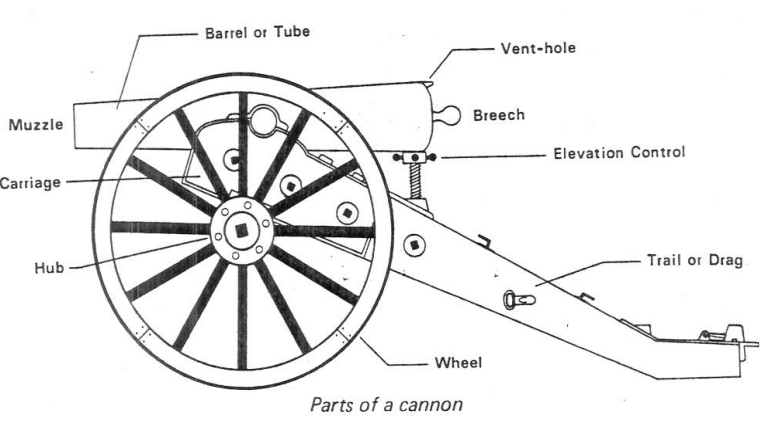
Important duties within a cannon crew were discussed known and trained for prior to any battle. Horses were need to move the cannons. If in the heat of battle, the decision to abandon the cannons, shoot the horses so the enemy had no way to move the cannons. Wheels could have been damaged or broken so and the carriage drag could have been removed to eliminate the use of the cannon. All of these considerations were taken into effect when getting ready for battle.
All cannon crews had different types of ammunition that was used. Each cannon type had different ranges, ammunition usages and tilts of the barrel. Below we will explore each type of ammunition and cannon types. The field artillery within the Civil War had four types of ammunition. They were the following: Solid, Shell, Case (Shrapnel) and Canister. Each type has different accuracy, ranges, and angles.
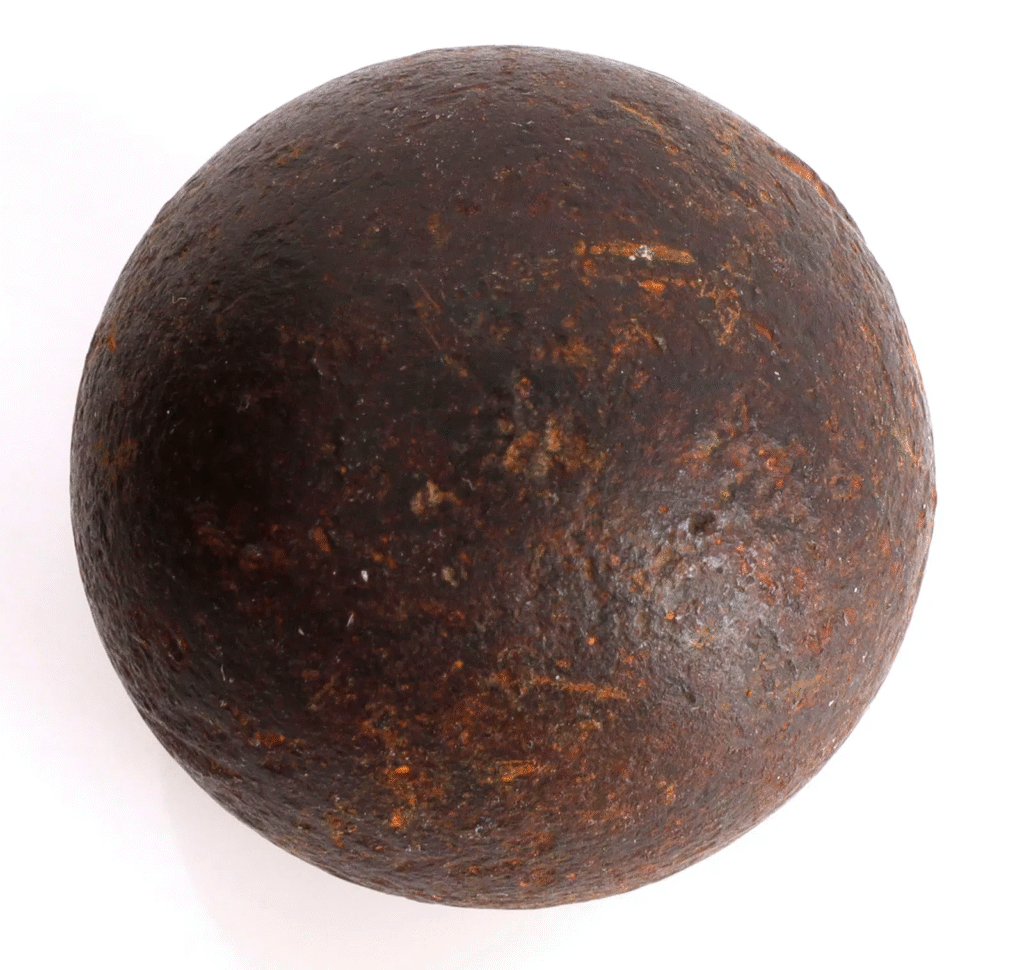
The first type of ammunition was defined as Solid cannonballs. Solid shot was a solid iron circle shell, primarily used on infantry that was in column or on the flank. These shots would use a bowling ball effect after it flew through the air. As it landed, it would normally take out horses legs within the Cavalry, or infantry walking through the fields of battle. This type of ammunition was the most accurate of the four types. Some of the different cannons could fire solid shot weights of 6, 10, 12, 14, and 24 pounders. Here is a picture of a cannonball below.
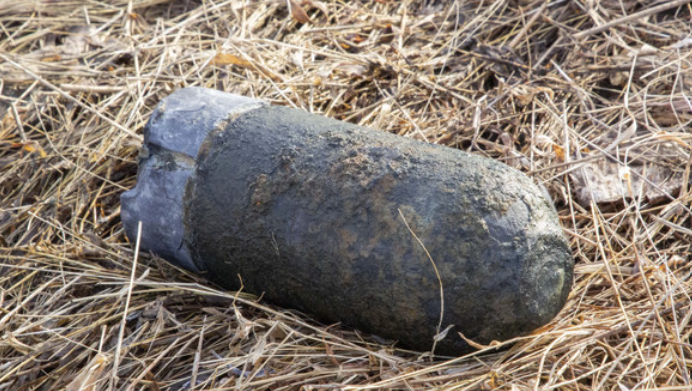
The second type of ammunition was defined as Shell. Shell explosives were hollow projectiles and filled with almost 100% black powder. As the fuses were cut in half to nearly right after they came out of the cannon, they lit the firing charge and it exploded. Shell shots were primarily used against fortifications, forts, structures, and enemy artillery. These types of shells are possibly between six to eight inches long. This type of shell could have been the one that was found on Little Round Top in 2022-2024 rehabilitation work that was done. Here is a picture of it below.
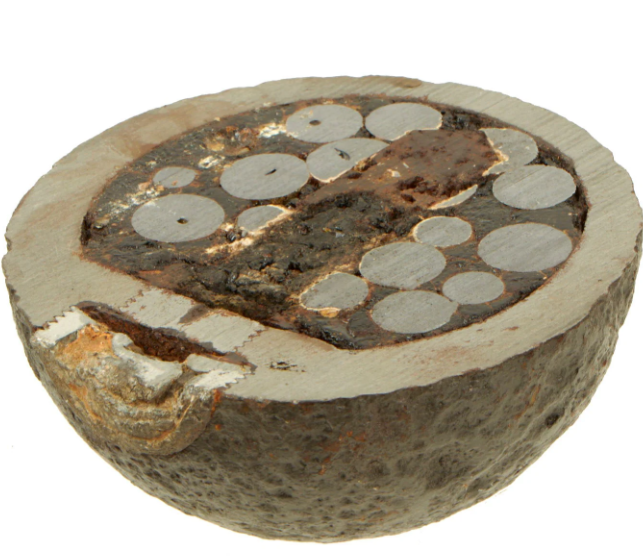
The third type of ammunition was the Case (Shrapnel) shot. It was comprised of a hollow shell filled with iron balls inside it. It was used against infantry at a long range of over 400 yards and most effective when the bursting charge exploded over the enemy’s head. These are more hard to to find together. Most have been exploded or partially exploded. However, there is a picture of some. These mini balls inside were like the size of walnuts within the main case shot. This one below is an example of a Confederate 12-pound case shot with the original fuse intact.
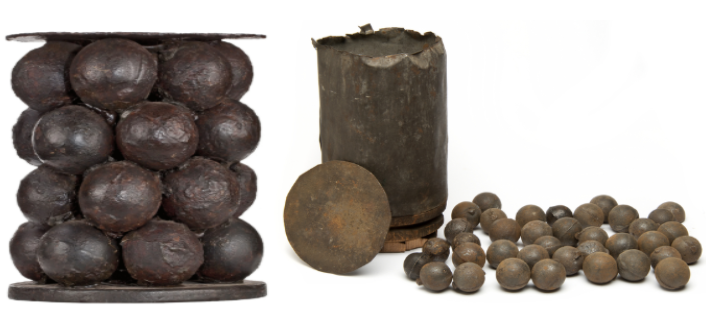
The fourth and final type of ammunition was the canister shot. It contained a thin metal can containing iron or lead balls in sawdust. It was then inserted into the muzzle and fired. When the cannon fired, the can ruptured and the canister would explode and cause the balls to make it like a enormous shotgun. Canister fire was only used when the enemy was becoming too close to the gun crews and infantry. It was usually used in defense with the possibility of being overrun. It was also known as grape shots. Here is a few pictures showing grape and canister characteristics.
Cannon crews had one goal and that was to hopefully destroy the enemy before the infantry took to the field of battle. As the infantry moved towards the cannon crews, the ammunition changed depending on the circumstances. Some stayed to the last minute to protect their guns and was in arm to arm combat with the enemy.