
Settlers from England, Ireland, and the rest of Europe were traveling by boat to the Americas in the 1500 and 1600s. As they arrived into a foreign land, small communities were created with grist and flour mills, tanneries, blacksmith shops, taverns, and log cabins. However, the land was being used by Native Americans that were living here for hundred of years already, and small fights and skirmishes were occuring on the frontier. One of these accounts occured to the family that created the area known as Cashtown.
Prior to moving to Cashtown, the Mark/Marsk family was living on the outskirts of Philadelphia in Whitehall Township. The family narrowly escaped a band of Indians that were passing through the region on October 8, 1763. John Nicholas Mark (1739-1823) gathered his wife Eve Schneider and their new baby Mary Barbara, and an apprentice boy named George Graff and ran to their nearby neighbors house, the Adam Deshler’s house. This house had thick stone walls and some soldiers were always stationed there. They made it to safety to the house, however, there were some casualties. Eve’s parents and her sisters didn’t survive. Some of the Mark and Schneider families that lived nearby were taken by surprise. The parents, and four children were killed, and two other daughters were severely wounded. Both of the daughters were tomahawked and scalped. One of the daughters, Magdalena, recovered and later married, while her sister, Dorothea never completely recovered and lived several years before passing away.
At this time, the Manor of Maske was being surveyed in 1766, which was a six mile by twelve mile parcel of land being sold off by William Penn, that became the second largest estate within Pennsylvania at that time. Land around the Maske on each side was being sold off to settlers. This same region was safe from the Six Nations with a treaty that was signed in 1736.
Due to the Indian raids, it was likely that the Mark family moved westward from Whitehall Township to start a life after the Indian encounter. John Nicholas Mark and his wife Eve Schneider Mark would start anew in a new community. The reason why they most likely moved is between the first and their second daughters was a period of three years. By the start of the American Revolution that started in 1775, John and Eve would have four children in total, with the last being a son in June 1775. However, in total, John and Eve would have seven children prior to their last that was John Mark on February 1st, 1786.
Skip ahead a few years now, with the Mark family growing up on the outskirts of Gettysburg that was just incorporated into a borough in 1786. Settlers moving westward from Gettysburg to Chambersburg along the dirt pike that ran between the town. People had to stop somewhere, so a small community was in the works into being created. The Mark (sometime seen as Marsk) family had an original log cabin and barn near the Pike sometime around 1795. This log-cabin that the Mark family constructed was one of the first stagecoach stops west of Gettysburg. At the start of the 19th century, here were the following ages of the Mark’s family:
- John Mark (father) – 61 years old
- Eve Schneider Mark (mother) – 57 years old
- Mary Barbara Mark (1st daughter) – 37 years old
- Catharine Mark (2nd daughter) – 34 years old
- Eva Mark (3rd daughter) – 29 years old
- Johann Peter Mark (1st son) – 25 years old and married to Anna Maria Hummel
- Daniel Mark (2nd son) – 22 years old
- Maria Magdalena Mark (4th daughter) – 17 years old
- John Mark (3rd son) – 14 years old
Adams County is created in January 1800 and becomes the county-seat. More settlers flood into the region and communities build. Prior to Peter Mark joining the 20th regiment of the Pennsylvania militia, Peter and Anna would marry around 1797, and had their first child in 1798. In 1803, he is promoted to Captain. A few years later, around 1805, Peter Mark constructs a brick building known as the Cashtown Inn, and it contain only four rooms. Peter Mark also becomes a county official around a decade later in 1810. He is one of three commissioners for the county.
Between 1810 and 1820, the Chambersburg pike expanded westward and past the Cashtown Inn. Peter Mark also applied for a tavern license. The tavern was also known as Mark’s Tavern or Mark’s Stand. The approval request was issued on November 1815 and was good for 24 years! He was able to obtain a tract of land from the William Penn Tract that was near Rocky Top. He was also involved in a developing idea of constructing a railroad in 1818 called the “Tapeworm Railroad” Within the 1820 census, Peter Mark and his family had a free colored man on their farmstead. He would also take his wagon and horses from the Inn to the Caledonia Iron Works that was a few miles up the road. During the 1840s, the Peter Mark applied for another license for the tavern and was approved. Sadly, Peter Mark died on November 27th, 1845 and is buried within the Flohrs Lutheran Cemetery which is down the street from Cashtown. His wife, Anna Maria Hummel Mark would pass away in August 1851 due to a severe illness. She was 73 years old.
In late September 1846, there was a public sale of the Peter Mark’s estate totally 94 acres of land, which about 65 acres were cleared. It also included the two story dwelling, the barn and the stables, the blacksmith shop and two log cabins. It was very suitable land since there was an underground spring underneath the two-story brick house. The sale was bought by a gentleman named Moses Smith in 1847. The sale didn’t last long since their family only owned it until 1854. During that time between 1847 and 1854, the Erie Railroad connected New York City to the Great Lakes and displaced the Erie Canal that only lasted 26 years of existance. Because of the railroad, settlers didn’t use wagon and horses as much and the stagecoach traffic through southern Pennsylvania slowed.
The Cashtown Inn was sold again in 1854 to the Mickley family along with the surrounding land. It could have been called the Mickley’s Hotel as well. Henry Mickley bought the property but his son, was Jacob Mickley was in charge of the Inn during the years of the Civil War. Cashtown was visited by the Confederate Army twice during the Civil War.
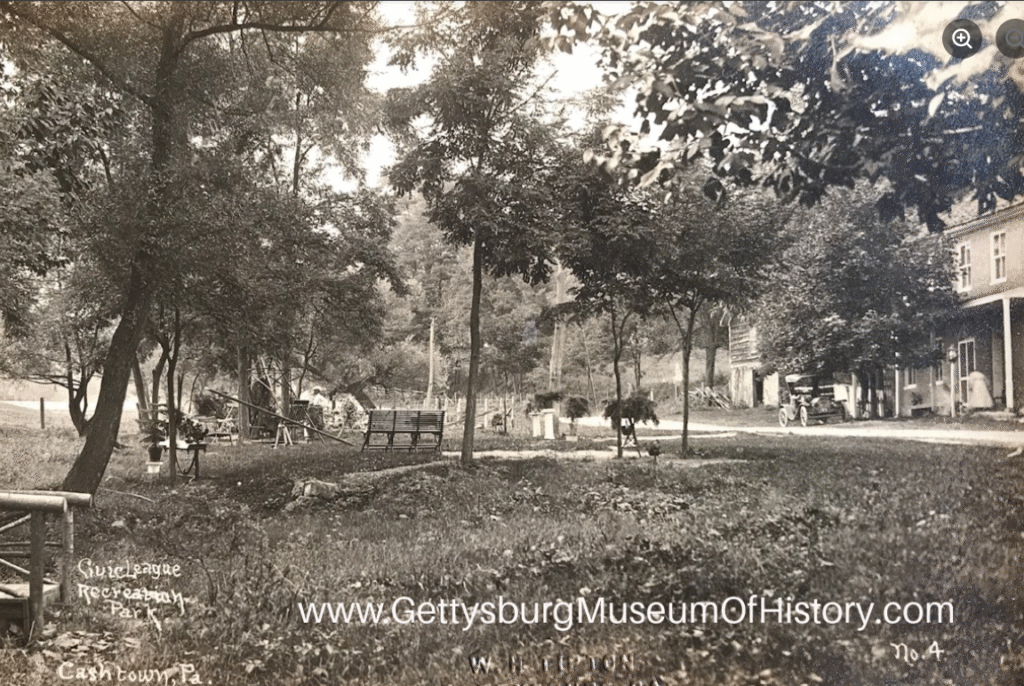
Forward a few years, this is what the Cashtown Inn and surrounding landscape looked like in the 1920s. Confederates would have marched these grounds sixty years prior.