Off the beaten path of the Gettysburg Battlefield maps and landscape that surrounds the town is a small house that is on a hill overlooking Marsh Creek. On this hill is the newest restoration of a farmhouse that was here during the Civil War, and the battle of Gettysburg. However, there are so many stories from civilians and stories about this plot of land west of town. This plot of land involves two civilians, a family, Union and Confederate soldiers, a death, and how the battle began. How did this monument arrive here and who paid for it? Let’s explore the Wisler House.
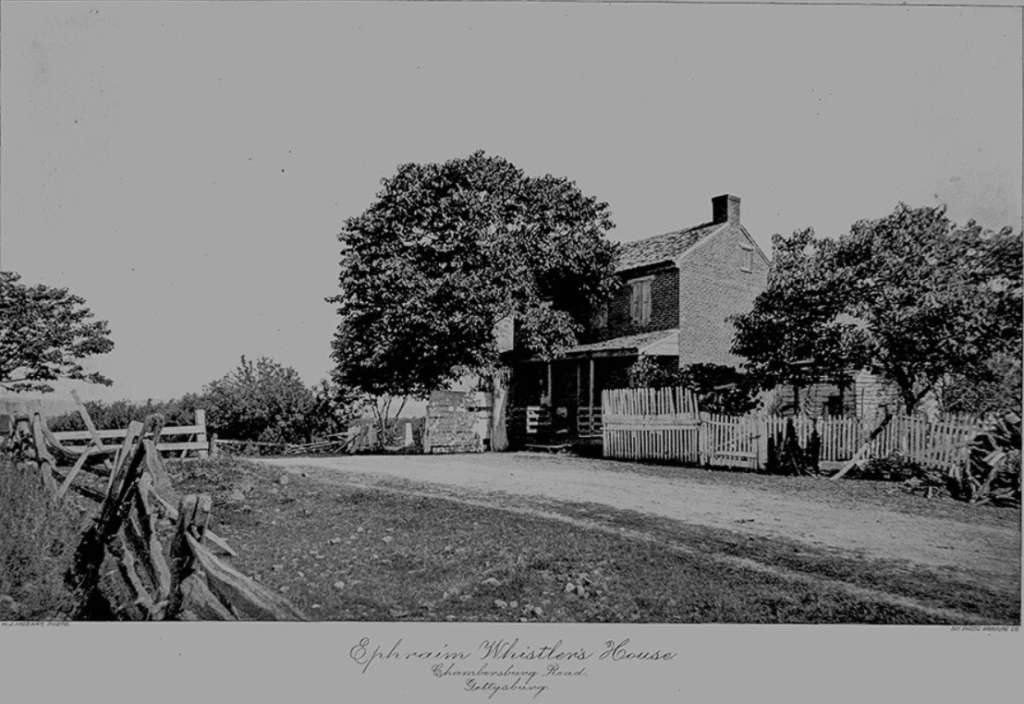
The Wisler House was built in 1857 along the old Chambersburg turnpike about 3 miles west of town. This house has been restored to what it used to look like and luckily there is an old photograph of the house that is on the Gettysburg National Park Service website that pictured here. You can see that the turnpike in front of the house is very close to the front porch. Looking west, which is away from the camera, looks to be fairly clear of tall trees and no structures. Let’s explore the residents of the house.
The owner at the time was Ephraim Wisler, who was a Mennonite farmer and a master blacksmith. He married his wife, Louisa Weikert in October 1853, and would have two children, George (1855) and Andrew (1857). According to the map survey between Wisler House and the Lohl Hill, the distance is about 4000 feet, which is where one of his neighbors were located across Marsh Creek.
Fast forward almost a decade after his marriage, and Confederate soldiers and Union soldiers are walking past his front porch over the last several days. His family is probably stressed and preparing for what lies ahead and taking precautions around the house. Then comes the news of a huge Confederate force arriving from the west, and sees dust in the skies from an approaching force approaching Cashtown. Due to the proximity of his house to Cashtown and the lack of buildings, he may have been able to witness the campfires at night on June 30th. On July 1st, everything changed.
On July 1st morning, Ephraim Wisler and his family was probably already awake and taking shelter in his basement with his family. The family probably noticed a few Union soldiers outside their door along the fenceline looking west. These soldiers were from the 8th Illinois Cavalry, and they were forming a small vidatte line. At least a few men saw this line of dust at this fenceline, including the following soldiers:
- 2nd Lt. Marcellus E. Jones
- Sgt. Levi Shafer
- Private Thomas Kelley
- Private George Sage
- Private James Hale
- Private H.O. Dodge
Sgt. Levi Shafer was in the process of getting ready to fire a shot, and 2nd Lt. Marcellus Jones stepped in. He says to him ” Give me the honor of opening up the ball”, and fires a carbine shot about 800 yards at 7:30 a.m. Now the distance comes into play. What is 800 yards in feet, which is about 2400 feet, which is the location of Marsh Creek. The Union soldiers could see the Confederate skirmishers moving towards them. Likely, the shot that Lt. Jones was one of the first, if not the first rifle shot, of the start of the Battle of Gettysburg. The regiment that was walking down the Chambersburg turnpike was likely that of the 13th Alabama regiment commanded by Colonel Birkett D. Fry.
This is where the history comes true later in a newspaper article in 1903. The paper suggest that a fellow farmer Samuel Lohl, on what is called Lohl’s Hill, has Confederates outside his door. They witness the first rifle shot from a ridge to their east (which would be the Wiser House) and they bring in a cannon that is likely a 3″ rifle ordnance. They fire a 12 pound solid shot at the Union soldiers on Wiser Ridge. That likely lands near the Wiser House where, according to July 1863 accounts, Mr. Wisler was outside and it lands near him and he goes into a stroke/shock episode. He walks gingerly into his house, lays in bed, and doesn’t leave for a month before he passes away in August 1863.
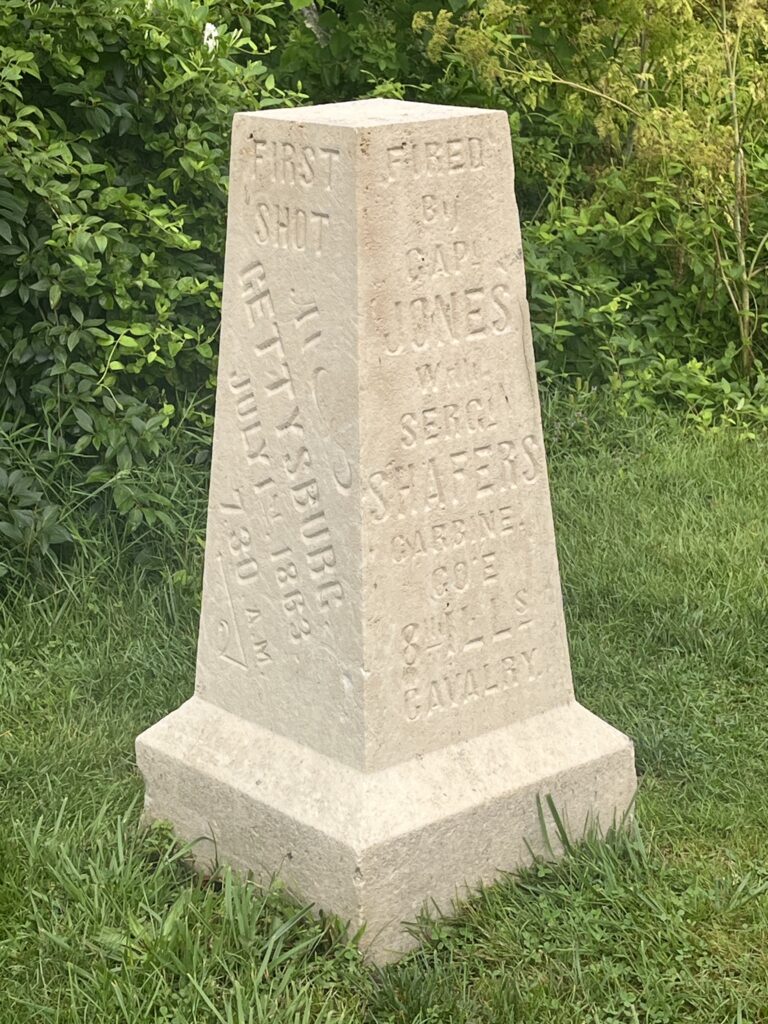
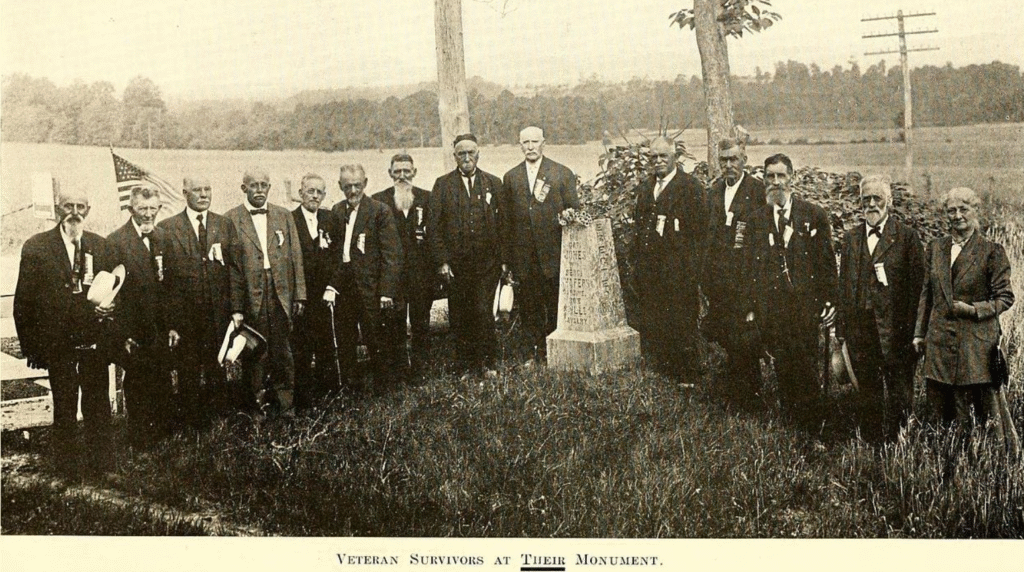
After the Civil War is over, the soldiers of the vidette post arrive back on Wisler Ridge in 1888. The soldiers of the 8th Illinois Cavalry, including Marcellus Jones and Levi Shafer, and Thomas Kelley return to the location they fired the shot from. They purchase a small plot of land to erect the monument the “three” of them bought and placed it here at the dedication in July 1887. The monument still stands today just near the intersection of Knoxlyn and Belmont Road along the Chambersburg turnpike west of Gettysburg. During the 50th anniversary, this photograph below was developed. Look at the landscape behind the monument, wide open and you can see for quite awhile. Currently, due to other houses and the trees, you can barely see a hundred yards.