
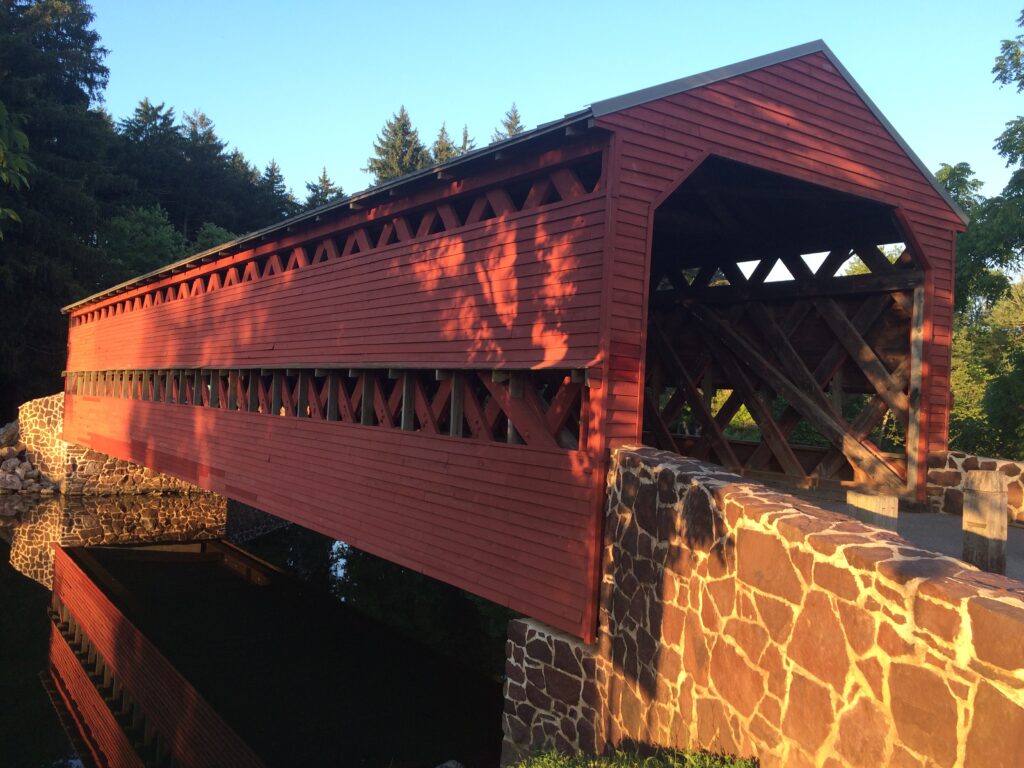
The history of this bridge minus the Civil War reference is amazing in itself. This covered bridge was originally built almost two hundred years ago in 1854 for approximately sixteen hundred dollars. The builder, David S. Stoner, created this trussle covered bridge that is about 100 feet long and 15 feet wide. There are multiple different ways to spell this bridge and they are the following: Sach’s, Sauck’s, Sauches, and Sock’s. The bridge spans Marsh Creek and was an important transportation viaduct for farmers to travel to Gettysburg. It was also an important scenic location that was used during the Civil War for both the Union and the Confederate armies.
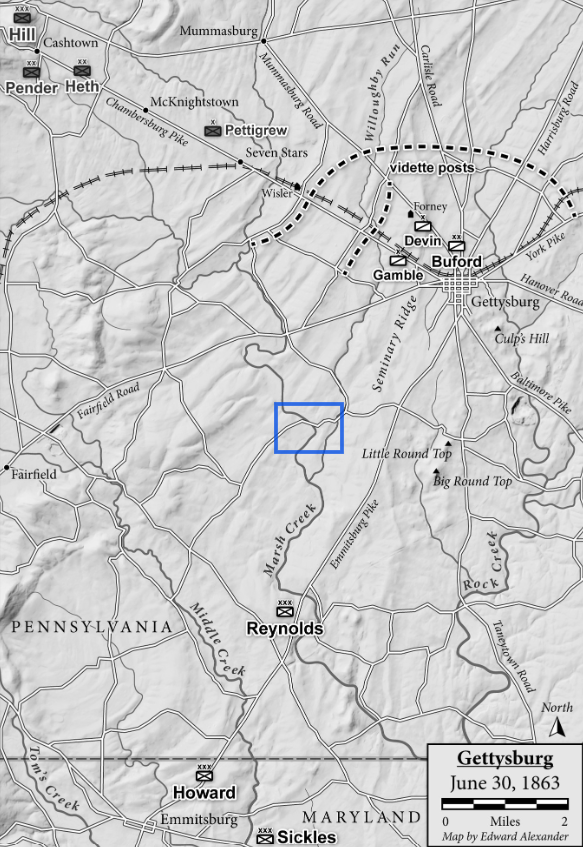
During the Gettysburg Campaign, the Confederate Army arrived into Gettysburg from the north and the west. The Federal (Union) army arrived from the south and the east. On June 30th, the Confederate Army was mainly near Cashtown, while the Union Cavalry was in and around Gettysburg with General Reynolds First Corps moving north from Emmitsburg. Some of the 1st Corps stayed the night near the White Farm, along the along the Pennsylvania/Maryland border. The area that’s marked with the blue square below shows the relative location of road across Marsh Creek.
On July 1st, the battle of Gettysburg began. Recent historical research shows that two Union regiments crossed the bridge prior to the morning attack.
- 1st Corps commanded by John Fulton Reynolds
- 3rd Division commanded by Abner Doubleday
- 1st Brigade commanded by Colonel Chapman Biddle
- 142nd Pa. commanded by Colonel Robert P. Cummins
- 336 soldiers with officers – 211 soldiers were loss on July 1st – 31 killed, 110 wounded, 70 captured/missing
- Col. Cummins was mortally wounded and died on July 2nd.
- First Corps commanded by John Fulton Reynolds
- 3rd Division commanded by Abner Doubleday
- 2nd Brigade commanded by Colonel Roy Stone
- 149th Pennsylvania commanded by Lieutenant Colonel Walton Dwight
- 450 soldiers with officers – 225 soldiers were loss on July 1st – 66 killed, 159 wounded
- Ltc. Dwight was wounded.
- One Confederate shot killed 3 Union soldiers: Captain Alfred Sofiel, Corporal Nathan Wilcox, and Private Edwin Dimmick
Both of these regiments originated between Fairfield Road and Emmitsburg Road and and marched up from Bullfrog Road and crossed Sachs Bridge along the Millerstown Road. As they reached the Peach Orchard, they intersected a staff officer from Reynolds Corps telling them of the fighting northwest of town near McPherson Ridge. The Confederate forces used the bridge on July 4th to retreat from Gettysburg.
Looking forward after the Civil War, the covered bridge went back to normal usage for farmers and vehicle traffic. The covered bridge was deemed a historical bridge in 1938, and was voted to close to vehicle traffic in May 1968.
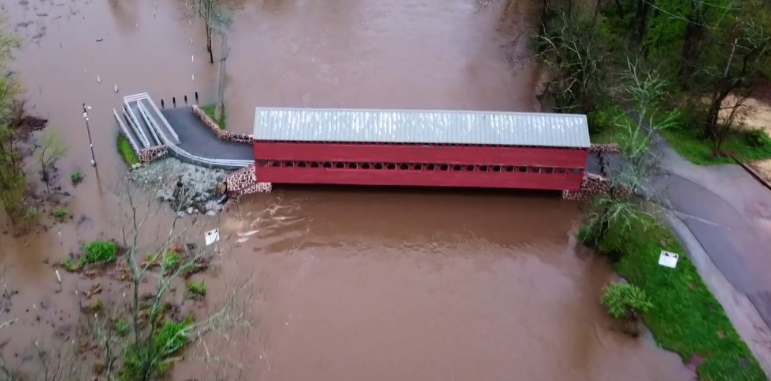
Sachs Covered Bridge is above Marsh Creek, which does flood during snow-melts. Below is a picture from April 2020 after a thaw that flooded the area. The parking lot that most people park at is on the right. As you can see, the bridge and surrounding landscape is mainly underwater. This image is from a drone shot.
In the summer of 1996, on June 19, a storm brought heavy rain and flooding across southern Pennsylvania. Anywhere from 8 to 12 inches of rain fell across Gettysburg and the result was heavy flooding across the region. Sachs Bridge was lifted of its abutments and washed downstream 100 yards onto the dam. It was rebuilt in 1996-97 with a restoration cost of $600,000. The bridge was placed at the same location on new concrete abutments, capped with stone, that were built 3 feet higher than the original abutments. As of January 2026, there’s a website that I’m trying to obtain to get pictures and radar of this event.