
This monument is just prior to the intersection that is near the Longstreet Tower Observation along Pumping Station Road. This monument for the state of Mississippi is highly important to show the location where their brigade left the Confederate side to attack the Union on July 2nd, 1863. However, Mississippi was the second state to secede from the Union in January 1861, following South Carolina that started the Confederacy in December 1860. This monument is dedicated to all 80,000 soldiers that fought for the Confederacy. Even though Mississippi fought for the South, another 17,000 soldiers fought for the Union. Of these numbers, about 550 of them where white, and the rest were black. These black soldiers were most likely slaves that found their way North using the Underground Railroad. At the time of the secession, there was about 45% of the population that was free, and the rest was slave.
The Mississippi monument was dedicated in October 1973. Of the soldiers that fought for the Confederacy, about 5,000 of those fought at Gettysburg. The rest of the soldiers were fighting the western theater and protecting Vicksburg, Mississippi and other locations within the Southeast United States. Of these 5000 soldiers, about 1500 became causalities. It was the fifth largest amount of soldiers from the twelve states of the Confederacy, and it was also the fifth highest of the casualty totals.
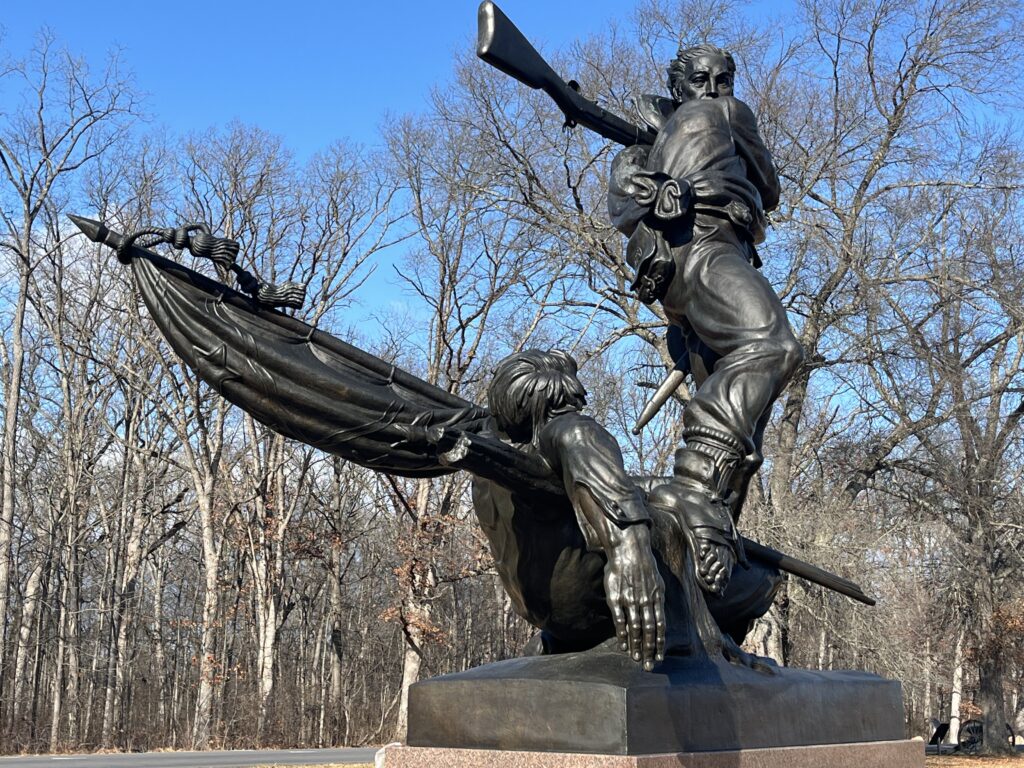
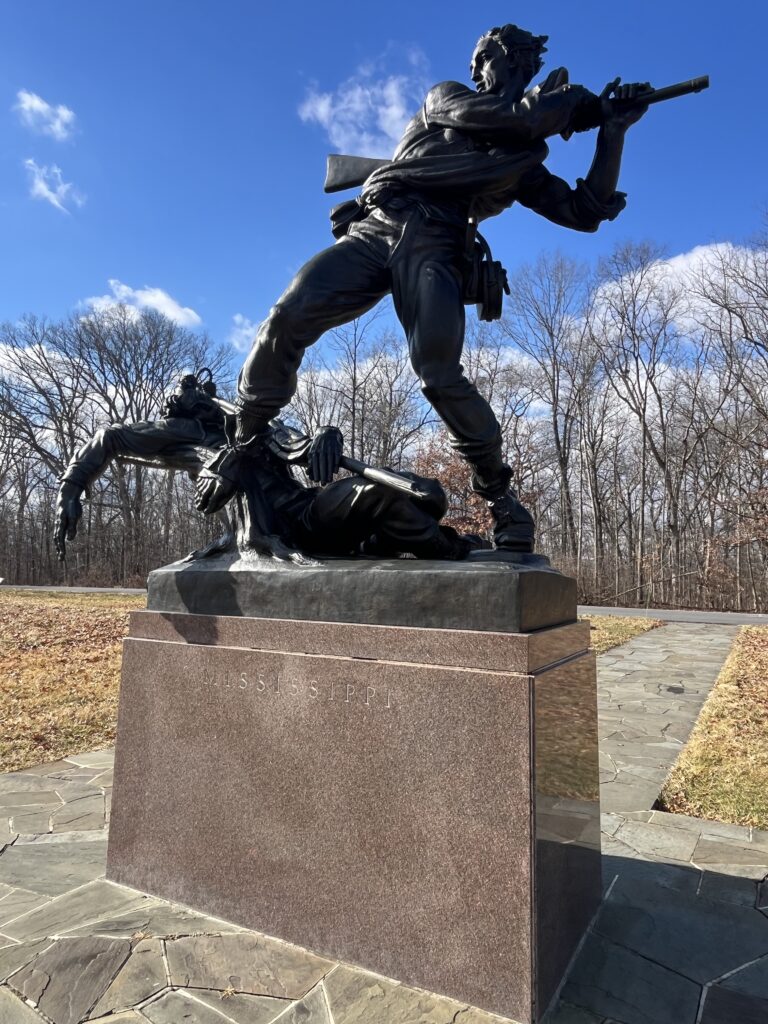
This monument was where Barksdale’s Mississippi brigade began their charge towards the Peach Orchard. The sculpture on the monument is moving and detailed. One foot is within a shoe, and another looks like a sandal, showing his toes. Soldiers had the lack of uniforms and shoes as the war continued. The monument represents the hand to hand fighting of the day. The color bearer is lying on the ground mortally wounded. His fellow comrade steps over the body and using his musket as a club to defend his comrade and the flag.
Their commander, Brigadier General William Barksdale, was a slave owner. Near the time that the state seceded from the in early 1861, he may have owned around 30 slaves and had a large plantation. This is one of the reasons why he was fighting for the Confederacy.
The brigade consisted of the 13th, 17th, 18th, and the 21st regiments. Even with the impeding charge upon Federal soldiers, he rode on horseback into battle and was a target. During the charge, he was wounded in the left knee by a bullet, followed by a cannonball to his left foot, and then hit by another bullet in his chest, thus knocking him to the ground. His own troops left him for dead, and he was carried to a Federal field hospital near the Joseph Hummelbaugh farmhouse. He passed away due to his injuries on July 3rd.
Even thought this is the state of Mississippi monument, there are two others on the battlefield. The statue for the regiment of the 11th Mississippi monument was placed behind the North Carolina and Tennessee monuments in 2000. The other monument is their marker where they reached near the stone wall in front of Bryan’s Barn on Cemetery Ridge along the Federal line.