
During the Civil War, Union and Confederate soldiers were mainly separated by an imaginary line called the Mason Dixon Line. This line continues into the 21st century as the border between Maryland and Pennsylvania. The battle occured in July 1863 and ended in April 1865 as General Robert E. Lee surrendered at Appomattox, Virginia. With the Union winning the war in the end, the regiments within the Federal Army wanted to construct monuments for the turning point win at Gettysburg. The veterans of the Civil War and states within the Union that sent soldiers to the war wanted to represent their bravery and sacrifice.
However, looking at the southern states, it was hard to gather the funds to construct monuments and statues on northern state battlefields. It took a few years after the battle for communities to understand that it was “the right thing to do” as to allow Confederate monuments. Generally speaking though, Gettysburg has monuments from the south, but vastly smaller in number compared to Union monuments. Except for a few monuments, the southern representation at Gettysburg are mostly the states the participated here.
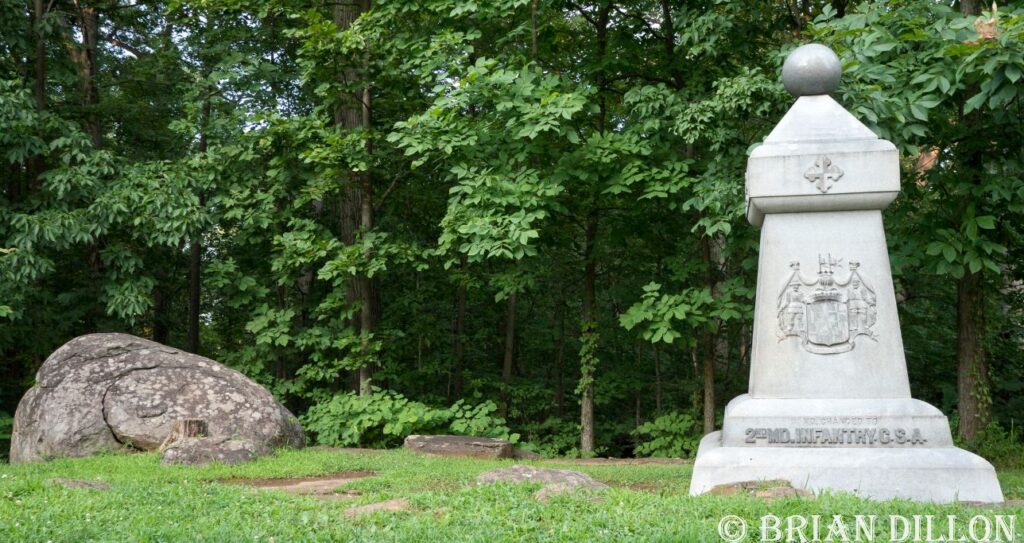
When veterans of the North and the South returned in 1888 for the 25th anniversary of the battle, southern soldiers would only find two monuments on the battlefield. The first was the 2nd Maryland Infantry C.S.A that is located at Culp’s Hill, that was erected in 1884. The other monument was the General Armistead monument at “The Angle” in 1887.
Most of the Confederate monuments were constructed between 25th and 50th anniversary with eleven monuments being displaced on the battlefield. However, the last state monument was for Tennessee and it was erected on the 2nd day of July in 1982. The monument is the only Confederate monument paid for entirely by private donations. Two other individual monuments to regiments or generals were placed on the battlefield around the turn of the century in 2000.