
A tavern in the borough of Gettysburg is called the Farnsworth House. Surprisingly, it was not called that during the battle of Gettysburg. At that time, it was called the Sweney Tavern. However, at the same time of the battle, a young man named Elon J. Farnsworth was arguing with his commanding officer not to make a charge. What happened to him? Let’s look at his life.
Elon J. Farnsworth was born on July 30, 1837 in Green Oak, Michigan. As he grew up, he was accepted to the University of Michigan. A party one night on campus left a fellow classmate dead as he was thrown out a window, and Elon was expelled. After this, he and his family moved to Illinois. At the start of the Civil War, he was appointed first lieutenant within the 8th Illinois Cavalry, and his uncle was in command. He remained first lieutenant until December 1861, where he became Captain and remained till the battle of Chancellorsville in May 1863.
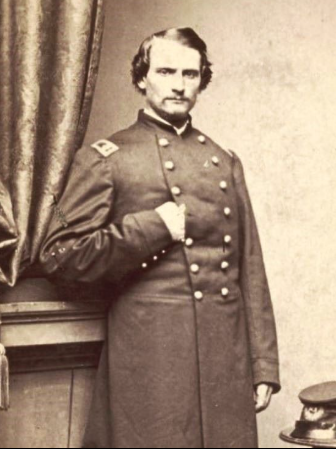
On June 28th, a few days before the battle of Gettysburg, President Abraham Lincoln nominated Elon J. Farnsworth of Brigadier General. However, no date was given for this promotion. That was the least of Elon Farnsworth worries as the Cavalry rode north and was told that the Confederate Army was approaching from the west. His commanding officer, Major General Alfred Pleanston was in command of the Cavalry Corps. He would ask Farnsworth to take command of the 3rd Division’s first Brigade. The 3rd division was commanded by Brigadier General Judson Kilpatrick. The first brigade consisted of the 5th New York, 18th Pennsylvania, 1st Vermont, and the 1st West Virginia Cavalry.
On the afternoon of July 3rd, after the famous Pickett’s Charge, BG Kilpatrick commands Farnsworth and the first brigade to charge down the slopes and drive the remaining Confederates out of the woods near the Slyder Farm on the southern edge of the battlefield. He hesitated multiple times saying it wasn’t worth the risk of his men, the horses, and the battle overall. However, it seemed at the time, that Kilpatrick wanted victory under his own terms as well. He called Farnsworth a “coward” and that’s when Farnsworth agreed, even though he knew it was certain death for many of his soldiers.
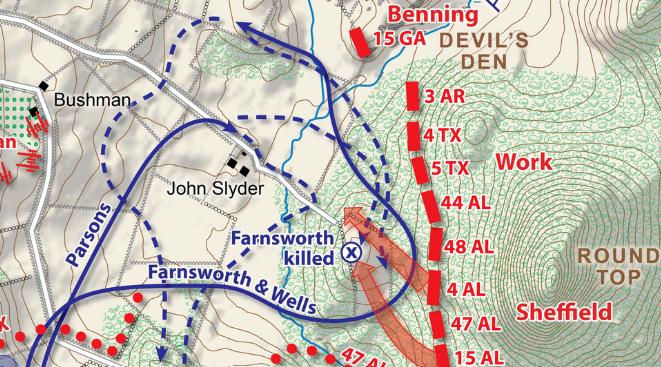
The land on the southern edge of the battlefield below the Round Tops are strewn with boulders, sharp elevation changes, and marshy ground. However, he was ordered to charge down these slopes into the Confederates soldiers. These Confederate soldiers were some of the same ones that remained after the charge onto Little Round Top the day before. As Farnsworth charged down the hill, his horse was shot from underneath him. He found another and kept with the original charge. On the third wave down the slopes, Farnsworth received five battle shots that left him for dead on the grounds. He was only 25 years old when he died.
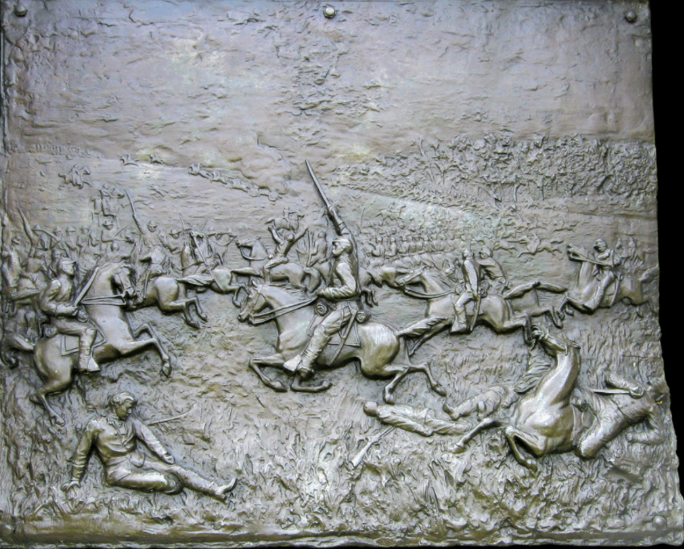
This is on the William Wells Monument at the southern edge of West Confederate Avenue before climbing/driving up to Big Round Top. He was a major that was in command of the first Vermont Cavalry under Elon Farnsworth.